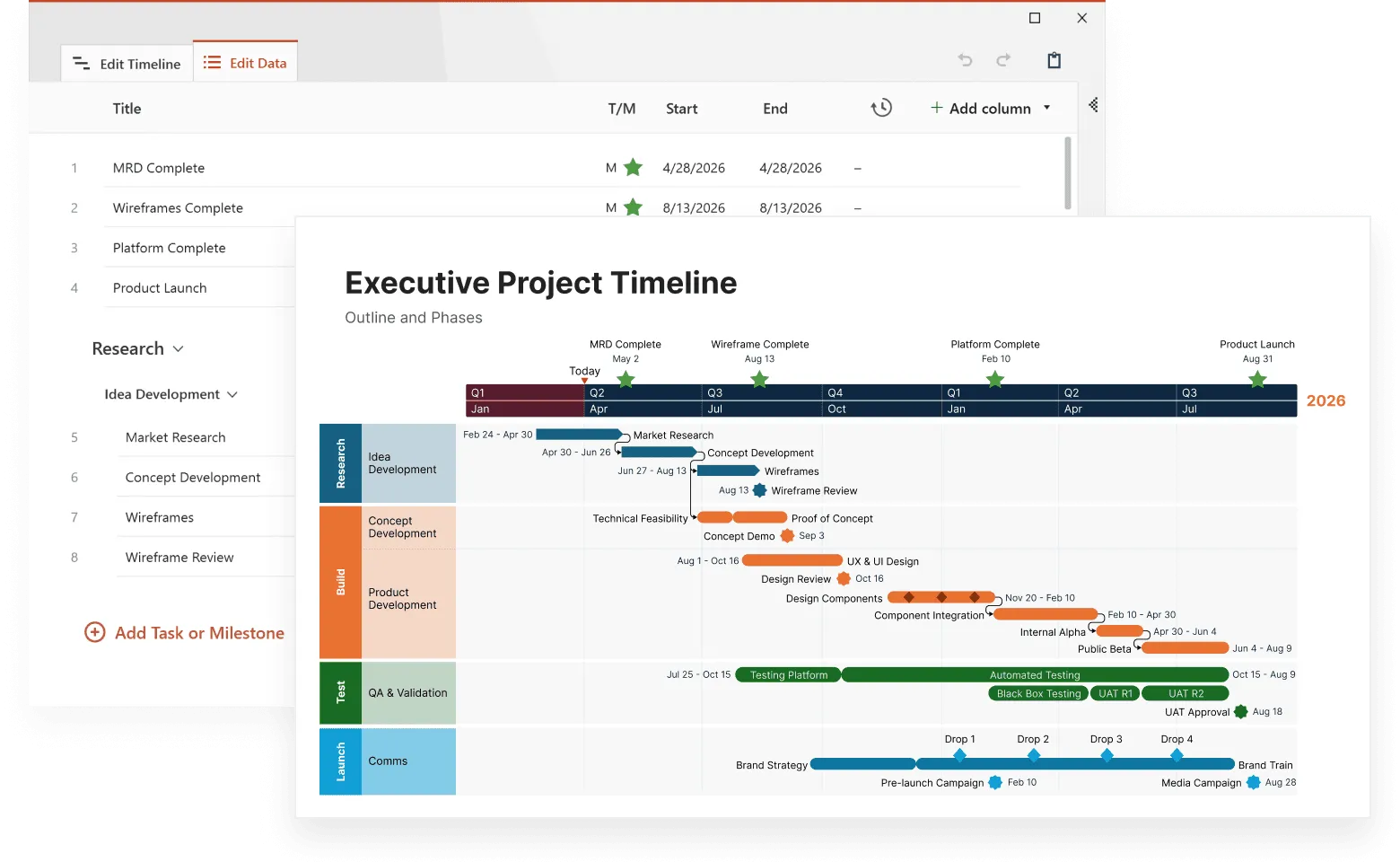
Ever wonder how we went from sailing ships to smartphones, or from empires to global superpowers? Modern history is the story of that transformation.
The modern era marks an age of extraordinary change, a time when exploration, industry, war, and innovation reshaped societies and connected the world. Following a modern history timeline reveals how global trade, revolutions, and technological breakthroughs built the interconnected world we live in today. From the first ocean voyages to the rise of digital technology, each century introduced new forces that continue to shape life in the twenty-first century.
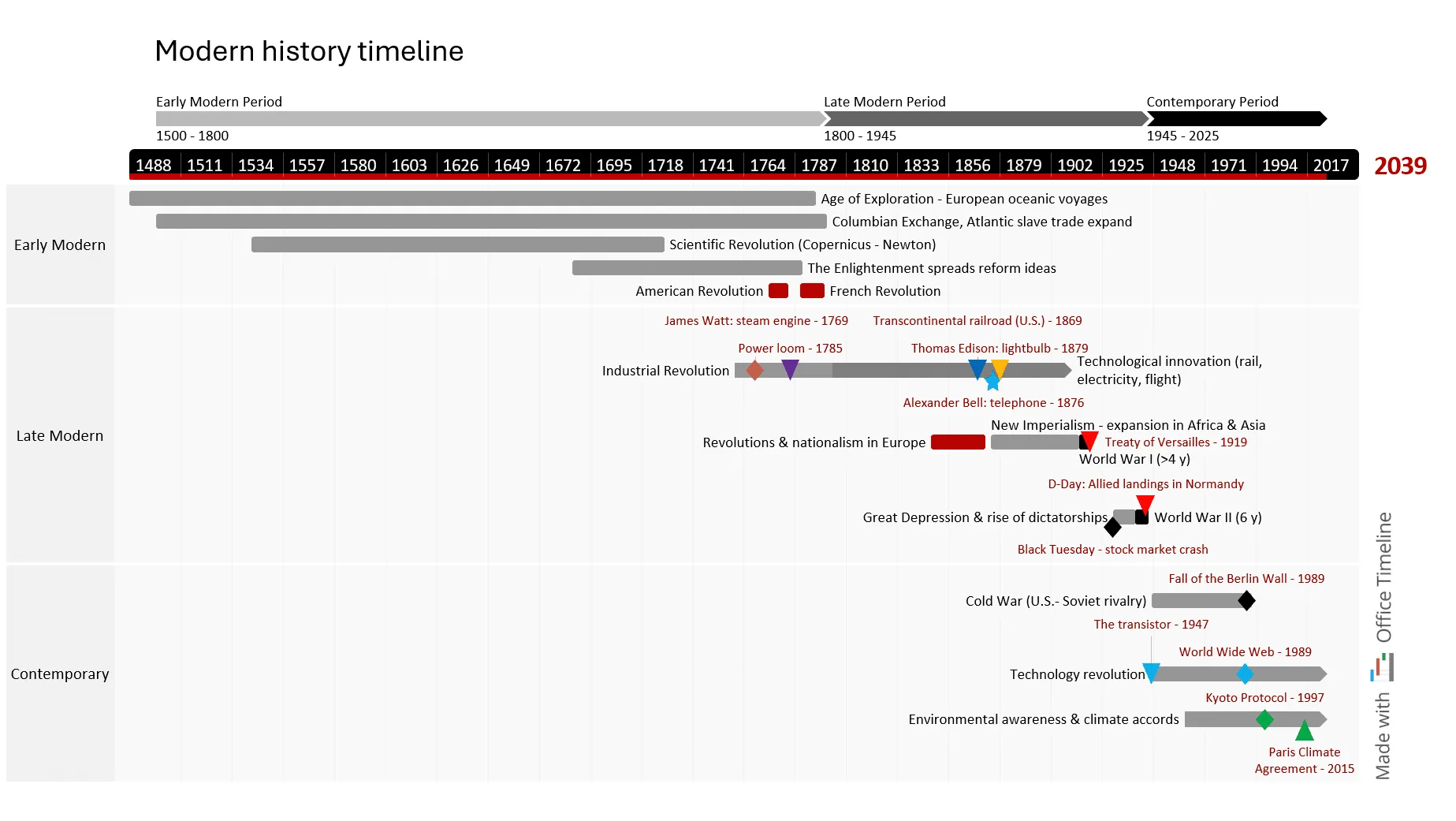
Historians generally divide modern history into three major phases: the early modern, late modern, and contemporary periods.
The early modern period (c. 1500–1800) bridges the medieval world and the industrial age, defined by exploration, Enlightenment thinking, and the growth of global trade. The late modern period (c. 1800–1945) covers the age of industrialization, empire, and global conflict, including both World Wars. The contemporary period (1945–present) begins after World War II and continues through the Cold War, globalization, and the digital revolution.
While exact boundaries vary, most scholars agree that these three phases trace the progression from early globalization to today’s interconnected world.
This article highlights the most significant events of modern history, connecting them to broader patterns within historical timelines. From the Industrial Revolution and world wars to globalization and the information age, each milestone shows how the modern world evolved. To learn more about how timelines capture and explain historical change, visit our complete guide on timelines, which includes examples, templates, and tools for creating your own.
What modern history timelines show
Looking at history through a modern timeline reveals how quickly the world began to change after 1500, and how those changes built upon one another. Each period in modern history adds a new layer of progress and complexity: discoveries spark industries, industries spark empires, and empires spark revolutions.
Three broad forces define this transformation:
- Change accelerating
Innovation, communication, and political movements speed up dramatically from the 18th century onward. - A world connecting
Trade, migration, and technology tighten links between continents and cultures. - Society transforming
New ideas about rights, science, and production reshape how people live and work.
Within that story, three major turning points stand out:
- The Industrial Revolution – beginning in the 18th century, machines and new production methods transformed economies, cities, and everyday life.
- The World Wars – two global conflicts that redrew borders, shifted power, and drove huge leaps in science and technology.
- The Cold War – a decades-long rivalry between superpowers that shaped politics, innovation, and globalization across the 20th century.
Taken together, these patterns show how each phase of modern history built on the last. They explain why some nations rose to global power, how technology accelerated global connections, and why past conflicts and inequalities still influence our world today.
Modern history is the story of how exploration, empire, industry, and information intertwined, turning a once-divided world into the fast, interdependent system we live in now.
Early Modern Period (c. 1500–1800): exploration, exchange, and the birth of globalization
The early modern era marks the moment when the world first became truly connected. From ocean voyages to revolutions in thought, these centuries redefined what people knew, traded, and believed, setting the stage for the modern world that followed.
Exploration and global connections
Beginning in the 1500s, European powers launched voyages that linked continents and created the first global networks of trade and exchange.
- Portuguese and Spanish explorers opened routes around Africa and across the Atlantic, connecting Europe, Africa, Asia, and the Americas.
- The Columbian Exchange transferred crops, animals, and diseases between hemispheres, transforming diets, economies, and populations.
- The rise of the Atlantic slave trade forcibly moved millions of Africans, creating an economy built on exploitation and human suffering.
These exchanges created wealth and contact on an unprecedented scale, but also set the stage for conflict, colonization, and inequality.
Empires and commerce
Global trade expanded through powerful empires and commercial ventures:
- Spain extracted silver from the Americas to fund a vast empire.
- Portugal, the Netherlands, and Britain established trading posts from India to Indonesia.
- Charter companies like the Dutch and British East India Companies grew into global powers, controlling trade routes and territories.
This early globalization tied distant economies together and encouraged competition that would later fuel industrial growth and empire-building in the 19th century.
Ideas that changed the world
At home, Europe was undergoing its own revolutions in thought and belief:
- The Renaissance revived art, literature, and classical learning, emphasizing human potential and creativity.
- The Reformation (beginning in 1517 with Martin Luther’s 95 Theses) challenged the authority of the Catholic Church and fractured Christian Europe.
- The Scientific Revolution replaced superstition with observation and reason, as Copernicus, Galileo, and Newton laid the foundations of modern science.
Knowledge spread faster than ever thanks to the printing press, which made books and ideas accessible to a growing literate public.
The Enlightenment and political change
By the 1700s, thinkers like John Locke, Voltaire, and Montesquieu were questioning monarchy and promoting liberty, equality, and rational government.
- England’s Glorious Revolution (1688) limited royal power and strengthened Parliament.
- Enlightenment ideas inspired the American Revolution (1776) and the French Revolution (1789), introducing concepts of democracy and citizens’ rights.
These revolutions turned Enlightenment ideals into action, marking the transition toward modern politics and mass participation in government.
From exploration to industrialization
The early modern period ended with a world more connected, informed, and ambitious than ever before.
- Global trade networks demanded higher production and faster transport.
- Scientific knowledge and capital accumulation paved the way for industrial invention.
- Revolutionary ideals redefined power, work, and citizenship.
By 1800, the conditions were in place for the Industrial Revolution, a technological and social transformation that would accelerate every process set in motion during the early modern age.
Late Modern Period (c. 1800–1945): industry, empire, and global conflict
By the early 19th century, the world entered a new and faster phase of change. The scientific curiosity, global trade, and political revolutions of the previous centuries had laid the groundwork for rapid industrial and social transformation.
Machines began to replace manual labor, new political ideologies challenged old monarchies, and empires expanded across continents in search of resources and markets. Urban life, nationalism, and global competition became defining features of this era.
The late modern period was marked by both astonishing progress and unprecedented destruction, from the rise of factories and steam power to two world wars that reshaped borders and beliefs.
It begins with the Industrial Revolution, the turning point that launched the modern industrial world.
The Industrial Revolution: when machines took over
The Industrial Revolution was one of the most significant turning points in human history. It introduced new machines and completely transformed how people lived and worked. Before industrialization, most people worked in agriculture or small workshops. After it, millions labored in factories powered by steam and coal.
According to the Encyclopedia Britannica, the Industrial Revolution began in Britain in the late 18th century and spread through Europe and North America during the 19th century. It marked the shift from hand production to mechanized manufacturing, revolutionizing transportation, communication, and industry.
What changed:
- Factories replaced small artisan workshops.
- Workers specialized in single tasks instead of producing entire goods.
- Rural populations moved to growing industrial cities.
- New social classes emerged, creating a distinct gap between industrial capitalists and laborers.
- Living standards eventually improved, though unevenly and slowly.
But this progress came at a human cost. Factory workers often endured harsh conditions (12- to 16-hour days for low pay in unsafe environments). Urban areas grew faster than housing or sanitation systems could handle, leading to crowded and polluted cities. The UK National Archives notes that early industrial towns like Manchester became symbols of both opportunity and exploitation.
Industrialization also changed how nations fought wars. Mass production made it possible to manufacture weapons, uniforms, and supplies on an unprecedented scale. Railroads allowed armies to move faster than ever before, making warfare both larger and deadlier.
The long-term impact of the Industrial Revolution is still felt today. It sparked sustained economic growth, technological innovation, and global trade systems that form the foundation of the modern, technology-based world we live in, transforming economies based on agriculture and handicrafts into economies driven by large-scale industry.
The 1800s: a century of upheaval
The 19th century was a time of extraordinary change, conflict, and transformation. The 19th-century timeline reveals how revolutions, wars, and social movements reshaped the global order and set the stage for the upheavals of the 20th century. Across continents, empires expanded, old systems collapsed, and new nations began to take shape.
America’s defining moment: The Civil War
The American Civil War (1861–1865) split the United States in two over slavery and states’ rights. The conflict’s economic reach was global: European textile industries relied heavily on Southern cotton, and disruptions in supply reverberated worldwide.
The war ultimately ended slavery and preserved the Union, but at a tremendous cost: more than 600,000 soldiers died, making it one of the deadliest conflicts in American history. It also introduced the world to the devastating potential of modern, industrial warfare, with railroads, rifles, and ironclads changing how wars were fought.
Revolution sweeps Europe
The year 1848 became known as the Year of Revolutions. Across Europe, citizens rose up demanding liberal reforms, national unification, and constitutional government.
- France once again overthrew its king and briefly established the Second Republic.
- German states sought unification under a single nation.
- Italians fought to end Austrian control and unite their peninsula.
- Hungarians demanded independence from the Austrian Empire.
Most uprisings failed, but they planted enduring ideas about democracy, self-determination, and national identity that would define European politics for decades.
Russia changes course
In 1861, Tsar Alexander II issued the Emancipation Act, freeing the serfs of the Russian Empire. For centuries, these peasants had been tied to the land and their landlords. The reform marked the beginning of Russia’s gradual transformation from a feudal empire into a modern state.
While life for freed serfs remained difficult, the policy was a monumental shift, one that set the stage for later industrial and political revolutions.
Britain expands in Asia
The First Opium War (1839–1842) between Britain and China ended with the Treaty of Nanking, forcing China to open several ports to trade and cede Hong Kong to Britain. The conflict marked the beginning of an era when European powers carved out spheres of influence across Asia.
The treaty symbolized both China’s weakening sovereignty and Britain’s rise as a global imperial power, themes that would dominate world politics for the rest of the century.
The 1800s were a century of industrial growth, revolution, and empire. The forces unleashed during this era (nationalism, technological progress, and colonial expansion) would shape the conflicts and alliances of the modern age.
Late 1800s: The age of invention
The timeline from 1870 to 1900 shows incredible bursts of innovation. These inventions changed daily life and set up the modern world.
Thomas Edison's light bulb, patented in 1879, meant people could work and play after dark safely. Electric lighting made it possible to work and socialize safely after dark. Cities remained active around the clock and factories ran longer hours.
Other major inventions from this era included:
- 1880: British seismologist John Milne developed the first modern seismograph, transforming the study of earthquakes.
- 1879: James Ritty invented the mechanical cash register, which helped make business transactions more secure and accountable.
- 1884: Hiram Maxim patented the first fully automatic machine gun, dramatically changing the nature of warfare.
These were far more than new gadgets. Each invention launched new industries, created new kinds of jobs, and reshaped society’s rhythm of work, communication, and security.
Early 1900s: the world speeds up
The timeline entering the 20th century shows humanity learning to fly and drive. These weren't just transportation improvements - they shrank the world.
The Wright brothers flew for 12 seconds in 1903. Within a decade, airplanes were carrying mail. By World War I, they were weapons.
Cars had existed since the 1880s, but they became practical and affordable in the early 1900s. Henry Ford's assembly line would soon make cars available to ordinary families, not just the rich.
Asia gets a new power
The Russo-Japanese War (1904-1905) shocked the world. For the first time in centuries, an Asian nation defeated a European power. Japan's victory announced that the age of European dominance was ending.
These early 20th-century changes created the foundation for everything that followed - two world wars, the rise and fall of empires, and the connected world we live in today.
World War I: the war that changed everything
The Great War started with a single gunshot on June 28, 1914. Archduke Franz Ferdinand of Austria-Hungary was assassinated in Sarajevo. Within weeks, most of Europe was at war.
The timeline of 1914 shows how quickly things escalated:
- July 1914 - Austria-Hungary declares war on Serbia.
- August 1914 - Germany declares war on Russia and France, invades Belgium; Britain enters the war in response.
- August 1914 - Russia mobilizes against Germany and Austria-Hungary.
- November 1914 - The Ottoman Empire joins the Central Powers (Germany and Austria-Hungary).
What people thought would be a short conflict turned into four years of brutal trench warfare that engulfed much of the world.
New weapons, new horrors
World War I introduced killing machines the world had never seen. Machine guns mowed down soldiers by the thousands. Poison gas choked men in trenches. Heavy artillery shells shattered entire towns, sometimes audible over 100 miles away.
The numbers tell the story: 8.5 million soldiers died. Millions more civilians perished from disease, starvation, and violence. Entire villages disappeared from the map.
Empires collapse
By 1918, the war had destroyed four major empires:
- Austria-Hungary is split into several new countries.
- German Empire lost territory and became a republic.
- Ottoman Empire was carved up by Britain and France.
- Russian Empire became the Soviet Union after revolution.
The peace that wasn't
The Treaty of Versailles in 1919 was supposed to end all wars. Instead, it planted seeds for the next one.
Germany had to pay massive reparations to the winners, give up territory to Poland, France, and other neighbors, accept full blame for the war and limit its military to a tiny force. These harsh terms left Germany economically devastated and humiliated, fueling resentment that extremist leaders would later exploit. As many historians note, the path from Versailles led directly to Hitler’s rise 14 years later.
World War I completely redrew the map of Europe and the Middle East. New countries appeared overnight. Old empires vanished forever. The war created the unstable world that would explode again in 1939.
The war transformed politics, technology, and society, and created the unstable conditions that would ignite World War II in 1939.
The 1920s and 1930s: between wars
The timeline from 1918 to 1939 shows a world trying to heal from one massive war while stumbling toward another. Economic disaster and political chaos marked these years.
The Roaring Twenties crash
The 1920s started with hope in many countries. America boomed. People bought cars, radios, and stocks. Women got the vote. Jazz music spread worldwide.
Then came October 29, 1929 - Black Tuesday. The U.S. stock market collapsed. Within hours, millions of Americans lost their life savings.
The Great Depression spreads
What started on Wall Street quickly spread across the globe. The timeline shows how connected the world economy had become:
- 1930 - Banks fail across America and Europe.
- 1931 - Britain abandons the gold standard.
- 1932 - German unemployment hits 6 million.
- 1933 - A quarter of American workers have no jobs.
Countries that stayed on the gold standard suffered most. They couldn't print money to help their economies recover. Nations that abandoned gold early - like Britain - recovered faster.
Politics turn dangerous
Economic pain created political anger. People wanted someone to blame. They wanted simple solutions to complex problems.
The timeline shows the rise of extremist movements:
- 1922 - Mussolini takes power in Italy.
- 1933 - Hitler becomes chancellor of Germany.
- 1936 - Spanish Civil War begins.
- 1937 - Japan invades China.
Banking panics made everything worse. When people lost faith in banks, they pulled out their money. Banks failed. Credit disappeared. Businesses couldn't get loans. More people lost jobs.
International trade collapsed too. Countries put up tariffs to protect their own industries. This made the depression deeper and longer.
Seeds of the next war
The economic chaos created perfect conditions for dictators. They promised jobs, pride, and revenge against those who had "betrayed" their countries.
In Germany, Hitler blamed the Treaty of Versailles, Jews, and communists for the country's problems. In Japan, military leaders said expansion into China would solve economic troubles.
The timeline shows how economic disaster led to political extremism, which led to World War II. The Great Depression didn't just hurt people's wallets - it helped destroy democracy in much of Europe and Asia.
World War II: the deadliest war in history
September 1, 1939 - German tanks rolled into Poland. Britain and France declared war two days later. The second world war had begun.
This wasn't like the last war. World War I stayed mostly in trenches. World War II moved fast across entire continents. It was fought in deserts, jungles, cities, and oceans. No place was safe.
Two sides form
Countries quickly chose sides as the war spread:
The Axis powers - why they teamed up:
Germany under Hitler had a clear plan called "Lebensraum" (living space) - they wanted to expand eastward into Poland, Russia, and other areas to give Germans more territory. Hitler also wanted to overturn the Treaty of Versailles and make Germany the dominant European power.
Italy joined Germany in June 1940, but only after Germany had already conquered France and looked like it was winning. Mussolini wanted to rebuild a Mediterranean empire like ancient Rome and saw an opportunity to grab territory in Africa and the Balkans while Britain was distracted.
Japan had been fighting in China since 1937, trying to create an empire across Asia and the Pacific. They needed oil and other resources, which led them to plan attacks on European colonies in Southeast Asia and eventually the U.S.
These three countries never really coordinated well - they had separate wars that happened to overlap.
The Allied powers - how the coalition grew
Britain declared war when Germany invaded Poland because they had guaranteed Poland's independence. For over a year (1940-1941), Britain and its empire fought Germany essentially alone.
Soviet Union had actually signed a peace deal with Hitler in 1939 and helped invade Poland. But Hitler broke that agreement and attacked Russia in June 1941, forcing Stalin to join the Allies.
United States had been helping Britain with supplies but stayed officially neutral until Japan attacked Pearl Harbor on December 7, 1941. This forced America into the war against both Japan and Germany.
The "dozens of other nations" include countries like France (which had a resistance movement after being conquered), China (which had been fighting Japan since 1937), and British dominions like Canada and Australia that joined immediately when Britain declared war.
The Blitzkrieg (Lightning war)
Germany's early victories shocked the world. Using "blitzkrieg" (lightning war) tactics, combining fast-moving tanks, aircraft, and motorized infantry, the Nazis overran much of Europe in a matter of months:
- 1940 - Denmark, Norway, Belgium, Netherlands, France
- 1941 - Yugoslavia, Greece
- 1941 - Deep into Soviet territory (Operation Barbarossa)
By late 1941, Nazi Germany controlled most of Europe. But then things started going wrong.
Turning points
Three major battles changed the war's direction:
- Battle of Britain (1940) - Germany failed to defeat the Royal Air Force, forcing Hitler to abandon plans to invade Britain.
- Battle of Midway (June 1942): The United States Navy dealt a crushing blow to Japan’s fleet, ending its expansion in the Pacific.
- Battle of Stalingrad (August 1942–February 1943): The Soviet Red Army encircled and destroyed Germany’s Sixth Army, marking the turning point on the Eastern Front.
The war comes home
This war targeted civilians like never before. Hitler's Holocaust claimed the lives of about six million Jews and millions of others, including Roma, Poles, and political prisoners, in Nazi-run concentration and extermination camps.
Across Asia, the Japanese military committed mass atrocities from 1937 to 1945, including the Nanjing Massacre and widespread abuse of prisoners and civilians.
Timeline of civilian suffering:
- 1941–1945: Nazi Holocaust exterminates millions.
- 1937–1945: Japanese forces commit widespread atrocities in China and Southeast Asia.
- 1940–1945: Allied and Axis bombing campaigns destroy major cities such as London, Dresden, Tokyo, and Hiroshima.
The end
D-Day (June 6, 1944) opened a second front in Europe. Allied forces landed in Normandy and began pushing toward Germany. Soviet forces closed in from the east.
In April 1945, facing inevitable defeat, Adolf Hitler committed suicide in his Berlin bunker. Germany surrendered eight days later, on May 8, 1945 (Victory in Europe Day).
The war in the Pacific continued until August 1945, when the United States dropped atomic bombs on Hiroshima and Nagasaki, leading to Japan’s surrender on August 15, 1945 (Victory over Japan Day).
This marked not only the end of World War II, but also the dawn of the nuclear age, an era shaped by the scientific race to develop atomic weapons, known as the Manhattan Project.
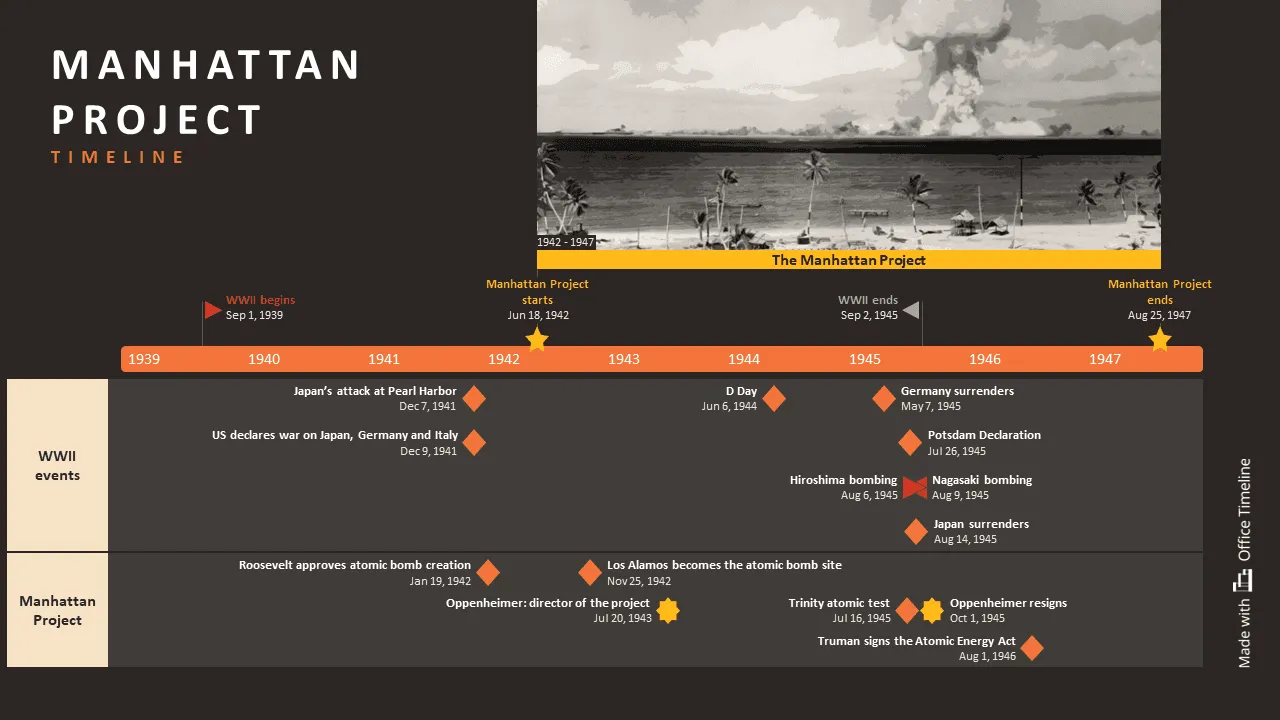
This visual timeline, made with Office Timeline, shows how the atomic bomb project ran in parallel with key World War II events, from Roosevelt’s 1942 approval to Japan’s surrender in 1945 and the project’s official end in 1947.
The cost
Between 40 and 50 million people died - mostly civilians. Entire cities lay in ruins. Millions more were refugees with no homes to return to.
But the war also reshaped the world. America and the Soviet Union emerged as superpowers. Europe's global dominance ended. The stage was set for a new kind of conflict - the Cold War.
See modern history more clearly
Try Office Timeline for free. Turn key events, eras, and transitions into clean timelines that reveal how the modern world took shape.
Contemporary Period (1945–present): a connected and changing world
When World War II ended in 1945, the world entered a new era. The devastation of the conflict left much of Europe and Asia in ruins, but it also marked the beginning of rapid reconstruction, decolonization, and global realignment. Two new superpowers, the United States and the Soviet Union, emerged to dominate world affairs, dividing the planet into competing spheres of influence.
At the same time, technology advanced faster than ever before. The atomic age, the computer revolution, and the beginnings of space exploration redefined what humanity could achieve, and what it could destroy. Former colonies gained independence, new nations were born, and global institutions like the United Nations sought to prevent another world war.
The contemporary period is defined by interconnection and acceleration: political power, information, and culture now move across borders instantly. From the Cold War to globalization and the digital age, this era tells the story of how a war-torn planet rebuilt itself into the complex, interdependent world we live in today.
The Cold War: a world divided
After 1945, two former allies, the United States and the Soviet Union, became global rivals. They never fought each other directly, but their competition defined international politics for nearly half a century. This period, known as the Cold War, lasted from roughly 1947 to 1991.
What they fought over
The Cold War was not simply a contest over borders or power. It was a struggle between two opposing worldviews and political systems: liberal democracy and capitalism in the West versus communism and state control in the East.
- United States: promoted democracy, free markets, and individual rights.
- Soviet Union: advanced communism, a state-controlled economy, and a collective society.
Both superpowers believed their system was superior and sought to spread their influence worldwide, from Europe to Asia, Africa, and Latin America.
Nuclear terror
Both nations amassed massive nuclear arsenals, enough to destroy civilization many times over. The fear of mutually assured destruction (MAD) dominated global politics.
Key milestones in the nuclear arms race:
- 1949: The Soviet Union successfully tests its first atomic bomb.
- 1952: The United States develops the hydrogen bomb, a far more powerful weapon.
- 1962: The Cuban Missile Crisis brings the world to the brink of nuclear war.
For 13 tense days in October 1962, U.S. President John F. Kennedy and Soviet leader Nikita Khrushchev negotiated over Soviet missiles in Cuba. The Soviets ultimately withdrew their weapons, avoiding catastrophe, but the crisis showed how fragile global peace had become.
Divided Europe
Nowhere symbolized the Cold War divide more than Germany. After World War II, it was split into occupation zones:
- West Germany (Federal Republic of Germany): under U.S., British, and French control.
- East Germany (German Democratic Republic): controlled by the Soviet Union.
Berlin, located deep in East Germany, was also divided. In 1961, East German authorities built the Berlin Wall overnight to prevent citizens from fleeing to the West. The Wall became the starkest symbol of the Iron Curtain separating Europe.
Military alliances
Each side formed military blocs to secure its sphere of influence:
- NATO (North Atlantic Treaty Organization, 1949): included the U.S., Britain, France, and other Western democracies.
- Warsaw Pact (1955-1991): united the Soviet Union and its Eastern European satellite states.
These alliances ensured that any local conflict risked escalating into a global confrontation.
Proxy wars
The superpowers fought indirectly by backing opposing sides in regional conflicts:
- Korean War (1950–1953): Communist North Korea, supported by China and the USSR, fought U.S.-backed South Korea.
- Vietnam War (1955–1975): Communist North Vietnam fought the U.S.-supported South Vietnam.
- Afghanistan (1979–1989): The Soviet Union invaded Afghanistan, facing U.S.-backed resistance fighters known as the Mujahideen.
These proxy wars caused immense human suffering without ever triggering direct U.S.–Soviet combat.
The space race
The rivalry extended beyond Earth. Each side sought to prove its technological and scientific superiority.
- 1957: The Soviet Union launched Sputnik, the first artificial satellite.
- 1961: Soviet cosmonaut Yuri Gagarin became the first human in space.
- 1969: The United States landed the first humans on the Moon, as astronauts Neil Armstrong and Buzz Aldrin took humanity’s “giant leap”.
The end
By the 1980s, the Soviet Union faced a failing economy and growing internal dissent. The costly arms race and war in Afghanistan had drained its resources. Reform-minded leader Mikhail Gorbachev introduced policies of glasnost (openness) and perestroika (restructuring) in an effort to modernize the system.
In 1989, the Berlin Wall fell, symbolizing the collapse of communist control in Eastern Europe. By December 1991, the Soviet Union dissolved, ending the Cold War without a nuclear conflict, but with one side, quite literally, giving up.
Empires fall: the age of decolonization and independence movements
While the superpowers faced off during the Cold War, the European empires that had dominated the world for centuries were collapsing. Between 1945 and 1960, more than 30 nations in Asia and Africa gained independence, reshaping global politics and ending the era of colonial dominance.
World War II had weakened European powers such as Britain and France, leaving them unable to maintain vast overseas territories. At the same time, the war’s message of liberation and self-determination inspired colonized peoples to demand the same freedom Europeans had fought for.
Why empires ended
World War II had weakened European powers. Britain, France, and others could barely defend their home countries, let alone control distant colonies.
The war also changed attitudes. The United Nations and emerging powers like the United States and Soviet Union opposed colonialism, though for different reasons.
If people fought against Nazi occupation in Europe, why shouldn't Africans and Asians fight against European occupation?
Different paths to freedom
Independence movements took various forms:
Peaceful transitions:
- India (1947) - Gandhi's nonviolent resistance wore down British resolve
- Ghana (1957) - Britain handed over power to Kwame Nkrumah
Violent struggles:
- Algeria (1962) - Eight-year war against France cost hundreds of thousands of lives
- Indonesia (1949) - Four-year fight against returning Dutch colonizers
Asia leads the way
Asian countries gained independence first. Japanese occupation during World War II had destroyed European prestige and trained local resistance movements.
Major Asian independence dates:
- 1946 - Philippines (from United States)
- 1947 - India and Pakistan (from Britain)
- 1949 - Indonesia (from Netherlands)
- 1954 - Vietnam (from France, after military defeat)
Africa follows
African independence came later but faster. Once it started, the movement swept across the continent:
- 1957 - Ghana becomes first sub-Saharan African country to gain independence
- 1960 - "Year of Africa" - 17 African nations become independent
- 1975 - Last Portuguese colonies (Angola, Mozambique) gain freedom
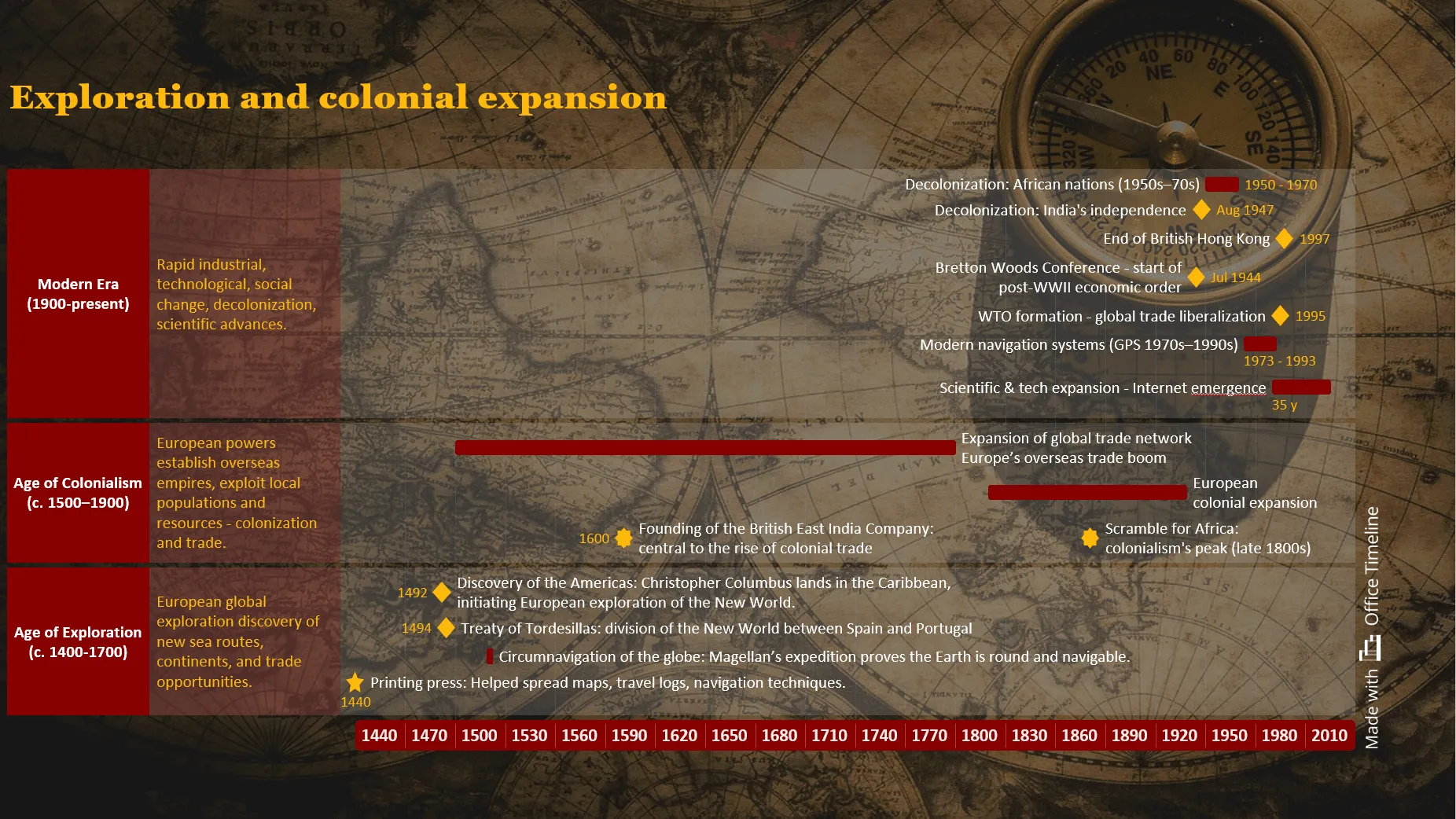
This visual timeline, made with Office Timeline, illustrates the long arc from the Age of Exploration (1400s) and European colonial expansion to the wave of decolonization after 1945. It shows how centuries of empire-building eventually gave way to independence movements across Asia and Africa.
Problems after independence
New countries faced massive challenges:
- Artificial borders - Colonial boundaries often divided ethnic groups or forced enemies together
- Economic dependence - Former colonies still relied on European markets and investment
- Lack of infrastructure - Few had universities, hospitals, or trained administrators
The world changes
By 1970, the United Nations had grown from 51 original members to 127. Former colonies now had a voice in world affairs and in shaping international policy.
These new nations often refused to pick sides in the Cold War. Countries like India, Egypt, and Yugoslavia formed the Non-Aligned Movement - they wanted to stay neutral and focus on their own development.
The rise of new global powers
The Cold War and the end of colonial empires reshaped global power dynamics. As old European empires disappeared and the U.S.–Soviet rivalry stabilized, new nations and regions began to emerge as influential forces. Economic strength, population growth, and resource control allowed several countries to assert their independence and regional leadership.
China returns
After decades of civil war and Japanese occupation, China entered a new era under communist rule in 1949. Led by Mao Zedong, the People’s Republic of China pursued centralized economic planning and social reform, often at immense human cost.
By the 1970s, under Deng Xiaoping, China began opening to global trade and investment, laying the groundwork for its later economic transformation.
Within a few decades, China reemerged as a major global power, capable of influencing both Western and developing nations.
Middle East oil and global influence
In the Middle East, oil wealth transformed nations such as Saudi Arabia, Iran, Iraq, and the Gulf states into key players on the world stage. The 1973 oil crisis, triggered by an OPEC embargo, revealed the region’s economic power. Oil prices quadrupled, shaking Western economies and showing how energy resources could shape global politics.
Over the following decades, petrodollars funded modernization, infrastructure, and international influence, particularly in the Persian Gulf. Control over energy supply remains a cornerstone of Middle Eastern geopolitical importance today.
East Asia’s economic boom
In East Asia, postwar recovery gave rise to a new economic powerhouse. Japan, devastated in 1945, rebuilt through technology, export-driven industry, and U.S. partnership to become the world’s second-largest economy by the 1960s. Its success inspired neighbors such as South Korea, Taiwan, Hong Kong, and Singapore, often called the Four Asian Tigers.
Through strategic investment in education, manufacturing, and innovation, these economies achieved unprecedented growth between the 1960s and 1990s.
A more complex world order
By the late 20th century, the world had become far more multipolar. Instead of European empires dominating the globe, dozens of independent nations pursued their own paths. Emerging economies in Asia, the Middle East, and Latin America added new voices to international decision-making.
The once-simple East vs. West divide of the Cold War gave way to a world of shifting alliances, economic interdependence, and rising regional powers, a balance that continues to define global politics today.
Technology reshapes the world
Since 1950, technological advances have compressed centuries of change into decades, an acceleration that would have seemed impossible to earlier generations.
The computer revolution started with room-sized machines in the 1940s that required teams of specialists to operate. By the 1980s, personal computers sat on home desks. The shift happened fast: the transistor in 1947 made smaller electronics possible, the first personal computer sold to hobbyists in 1975, and by 1984 Apple's Macintosh brought computers to ordinary people with a mouse and visual interface.
Then came the internet. What began in 1969 as a military project linking four universities became, by the 1990s, the most transformative communication tool since the printing press. Tim Berners-Lee created the World Wide Web in 1989, commercial internet service went mainstream in 1995, and within a decade, social media platforms were connecting billions of people across the planet.
Digital technology fundamentally restructured how the world works: how people communicate, how businesses operate, how information spreads, and how power is distributed. Countries that mastered these technologies gained enormous advantages. Those that didn't fell further behind.
Environmental awareness
For most of modern history, environmental damage was seen as the unavoidable price of progress. That assumption started cracking in the 1960s and shattered completely by the end of the century.
Rachel Carson's 1962 book "Silent Spring" exposed how pesticides were poisoning ecosystems. The first Earth Day in 1970 drew 20 million Americans, signaling that environmental concerns had moved from fringe activists to mainstream politics. The 1986 Chernobyl nuclear disaster proved that environmental catastrophes don't respect borders; radiation spread across Europe regardless of Cold War divisions.
By 1988, scientists confirmed what many suspected: human activity was changing the planet's climate. The evidence became impossible to ignore: rising global temperatures, melting Arctic ice, rising sea levels, and increasingly severe weather events.
International efforts followed. The 1992 Earth Summit brought together 178 countries. The 1997 Kyoto Protocol set the first global emissions targets. The 2015 Paris Agreement committed nearly every country to climate action. But agreements proved easier than action. Countries struggled to balance economic growth with environmental protection, and progress remained frustratingly slow.
What changed wasn't the science, it was the realization that environmental issues weren't separate from economic and political ones. They were central to how the modern world could continue functioning at all.
Globalization
The late 20th century created the most connected world in human history. Technology, the end of the Cold War, and economic policies combined to move goods, money, and people across borders faster than ever before.
The effects were dramatic and uneven. East Asian countries like South Korea and Taiwan experienced explosive growth. Multinational corporations accessed global markets and cheaper labor. Consumers worldwide could buy products that would have been impossibly expensive or unavailable a generation earlier.
But the same forces that created winners also created losers. Manufacturing workers in Western Europe and North America saw their jobs move overseas. Small farmers in developing countries couldn't compete with industrial-scale agriculture. Local cultures faced pressure from global brands and media. The environmental costs were often hidden: shipping emissions, deforestation for export crops, and pollution concentrated in manufacturing hubs.
The 2008 financial crisis revealed just how interconnected everything had become. Problems in American banks spread globally within weeks, proving that in an integrated world economy, distance no longer provided protection.
What these connections teach us
The modern history timeline is a story of acceleration, connection, and consequence.
Change happens faster than people expect. The Industrial Revolution transformed work and cities within a generation. World wars redrew maps in months. The internet went from lab experiment to daily necessity in two decades. Each generation has faced more rapid transformation than the one before.
Everything connects. Local decisions have global consequences. A war in Europe becomes a worldwide conflict. An economic collapse in America becomes a worldwide depression. A virus in one city becomes a pandemic. Technology that connects us also means problems spread faster.
Today's world is the direct result of the patterns visible in this timeline. Why some nations dominate global trade, how environmental problems became international crises, what makes modern conflicts different from past wars? Modern history provides the answers.
Understanding these connections matters because history isn't finished. We're still writing it. The choices made today will shape tomorrow's world just as past decisions shaped ours. By seeing how we got here, we can better navigate where we're going.
Frequently asked questions about modern history timelines
People often search for specific information about modern history timelines. Here are the most common questions and clear answers about the events that shaped our world.
A modern history timeline tracks major events from around 1500 to today. It shows how the Industrial Revolution, world wars, technological advances, and globalization connect to create the world we live in now. Understanding this timeline helps explain current global politics, economics, and social issues.
The Industrial Revolution (roughly 1760–1840) transformed the world’s economies and societies. It shifted production from handcrafting to machine manufacturing, creating modern cities, wage labor, and new social classes. It also sparked advances in transportation, energy, and communication that continue to shape modern life.
Without it, we wouldn’t have mass-produced goods, global trade networks, or technology-driven industries.
World War I lasted from 1914 to 1918. It began after the assassination of Archduke Franz Ferdinand of Austria, but deeper causes included rival alliances, militarism, and competition among European powers.
The war led to the collapse of major empires (the German, Austro-Hungarian, Ottoman, and Russian) and redrew borders across Europe and the Middle East. It caused immense loss of life, and created widespread economic and political instability. The harsh Treaty of Versailles (1919) sowed resentment in Germany, helping set the stage for World War II two decades later.
The Cold War ended between 1989-1991 when the Berlin Wall fell and the Soviet Union collapsed. This sudden change created 15 new independent republics, ended the nuclear standoff between superpowers, and allowed the United States to become the world's dominant power until China's rise in the 2000s.
Technology transformed society in distinct waves of innovation:
- Early 1900s - Electricity, automobiles, and telephones reshaped work and daily routines.
- Mid-1900s - Television, commercial aviation, and nuclear power connected the world.
- Late 1900s - Personal computers and the internet revolutionized communication and business.
- 2000s - Smartphones, artificial intelligence, and social media redefined how people interact, learn, and work.
Each wave brought new opportunities and new challenges, as societies adapted to faster communication and global interdependence.