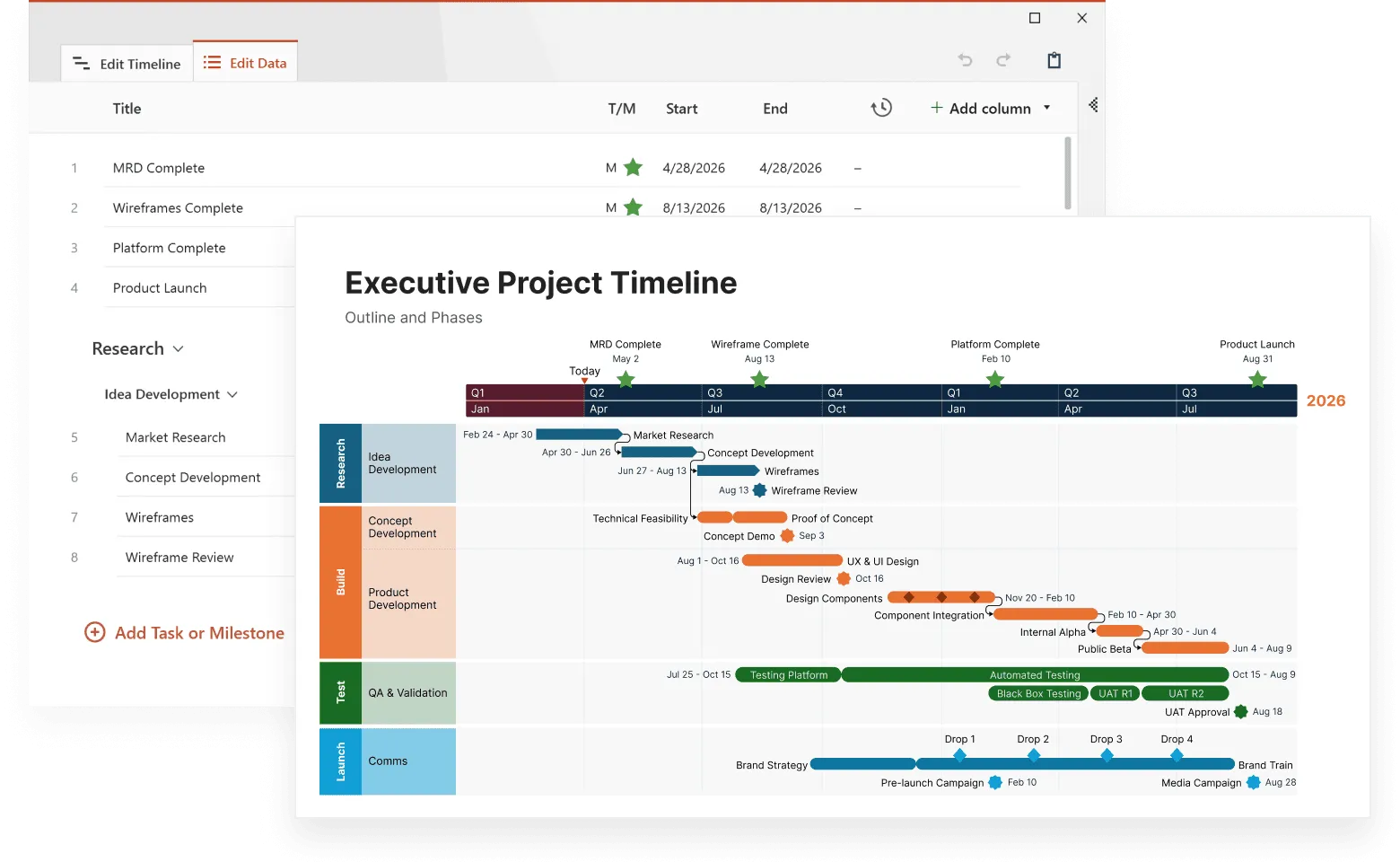
When you think about World War I or World War II, what comes to mind? Probably a mix of famous battles, dates, and turning points that somehow changed everything. But here's the thing: these wars were so complex that understanding them without a clear timeline is like trying to solve a puzzle with half the pieces missing.
Both world wars involved dozens of countries fighting on multiple continents at the same time. Imagine tracking what's happening in Europe while battles rage in Africa and the Pacific, all while political revolutions are reshaping entire nations. That's why historical timelines are helpful, but most of all, they're necessary for making sense of it all.
This article explores what makes these conflicts true world wars, walks through the key events of both wars using a timeline approach, and shows you how to create your own timelines to better understand history's most complex conflicts.
What makes a war a "world war"?
Not every big conflict gets called a world war. Historians look for specific things: major powers fighting each other, battles happening across multiple continents, and impacts that reshape how the world works. Only two conflicts clearly meet all these criteria, though some earlier wars came close.
The Seven Years' War (1756-1763) is sometimes called "World War Zero" because it was fought on five continents. The Napoleonic Wars (1803-1815) also had global reach through colonial empires. But World War I and World War II were different because of their scale and the fact that entire societies were mobilized for war, not just armies.
What stops us from having world wars today? Nuclear weapons, international organizations designed to prevent global conflicts, and economies so connected that total war would hurt everyone involved.
World War I: when the old world ended (1914-1918)
World War I marked the end of an era and the beginning of a new, uncertain world. What started as a regional crisis in the Balkans quickly escalated into a global conflict, driven by tangled alliances, nationalism, and imperial ambition. The war redrew borders, toppled empires, and changed the nature of warfare forever.
How it started: the alliance trap
Europe in 1914 was divided into two opposing groups. On one side: Germany, Austria-Hungary, and Italy. On the other: Britain, France, and Russia. When Archduke Franz Ferdinand was shot in Sarajevo on June 28, 1914, it triggered a chain reaction that pulled everyone into war within weeks.
This shows why timelines matter. The assassination didn't directly cause a world war—it was the sequence of events afterward. Austria-Hungary declared war on Serbia, Russia backed Serbia, Germany backed Austria-Hungary, France backed Russia, and Britain entered when Germany invaded Belgium. Each decision happened in response to the previous one, creating a domino effect that a timeline makes crystal clear.
The war's progression: from movement to stalemate to breakthrough
World War I went through distinct phases that you can only see clearly with a timeline:
1914: The war of movement - Germany tried to knock out France quickly before turning to fight Russia. The plan failed at the Battle of the Marne in September, just 30 miles from Paris.
1915-1917: The deadly stalemate - Armies dug trenches from Belgium to Switzerland. The Battle of Verdun lasted 302 days in 1916 with over 700,000 casualties. The Battle of the Somme the same year killed over a million people, including 57,000 British soldiers on the first day alone.
1917: The turning point - Two revolutions hit Russia. America entered the war. Russia eventually dropped out, freeing up German troops for a final push.
1918: The end - Fresh American troops helped break the stalemate. Germany's last desperate attacks failed, and the war ended on November 11.
Multiple fronts, one connected war
While the Western Front gets most attention, World War I was fought simultaneously in Eastern Europe, Italy, the Middle East, Africa, and at sea. German submarines tried to starve Britain, while Britain's navy blockaded Germany. The key insight from timeline visualization: these weren't separate wars—they were connected. When Russia collapsed, Germany could move troops west. When America entered, it tipped the balance for good.
World War II: the most complex conflict ever (1939-1945)
World War II was the deadliest and most widespread conflict in human history, involving more than 30 nations and reshaping the global order. The war’s complexity lay not only in its scale but also in the series of political and military decisions that led to it.
The road to war: when diplomacy failed
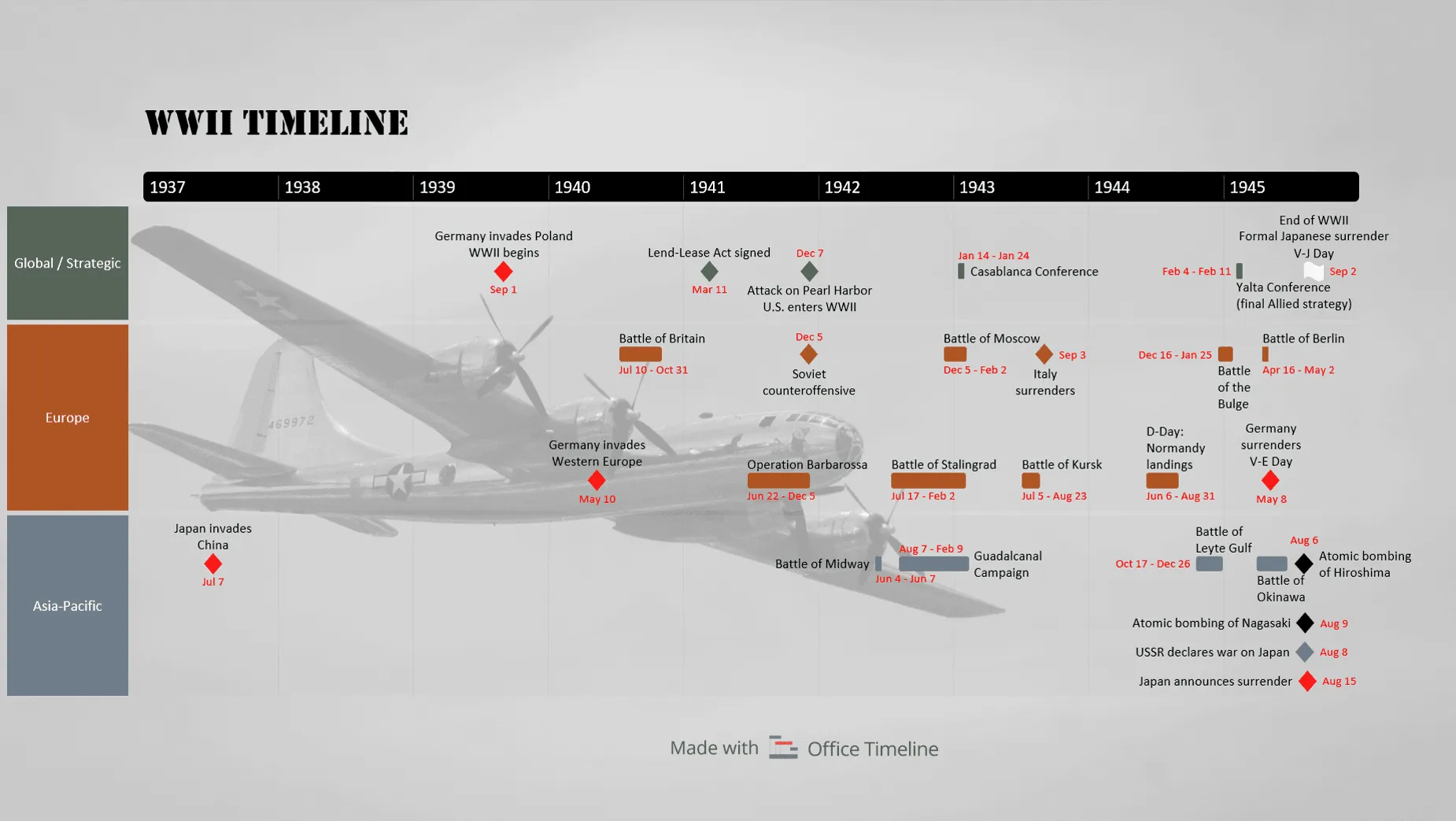
World War II didn't start suddenly. The timeline shows a series of escalating crises: Japan invaded China in 1937, Germany took Austria and Czechoslovakia in 1938, and the Munich Agreement failed to stop Hitler's expansion.
The final trigger came when Germany and the Soviet Union secretly agreed not to fight each other in August 1939. This freed Hitler to invade Poland on September 1, which brought Britain and France into the war.
Three years that changed everything (1939-1942)
1939-1940: Germany dominates - Poland fell in weeks, then Norway, Denmark, Netherlands, Belgium, and France. Britain stood alone.
1941: The war goes global - Germany invaded the Soviet Union with nearly 4 million troops on June 22. Japan attacked Pearl Harbor on December 7, bringing America fully into the war.
1942: The turning point - Three major battles changed everything: Midway in the Pacific (Japan lost four aircraft carriers), Stalingrad in Russia (Germany's advance stopped), and El Alamein in Africa (Britain's first major victory).
The race to victory (1943-1945)
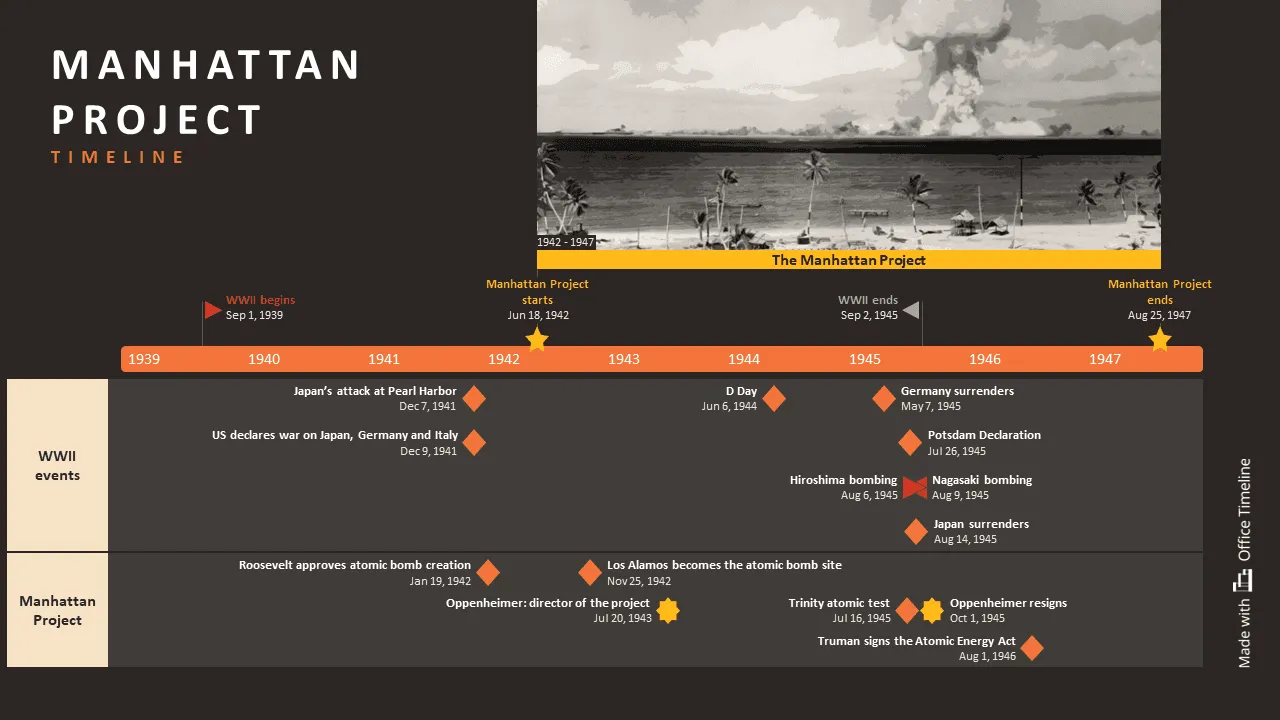
By 1943, the Allies were winning on all fronts. The timeline shows how events reinforced each other: D-Day landings in June 1944 opened a second front in Europe just as the Soviets launched massive offensives in the east. Germany couldn't fight everywhere at once.
The war ended with atomic bombs dropped on Hiroshima and Nagasaki in August 1945, introducing weapons that changed warfare forever.
Creating your own timeline
If you want to understand these conflicts better, making your own timeline is incredibly helpful. Here's how to approach it:
Start with major events - Pick 10-15 key moments for each war. Don't try to include everything at first.
Show connections - Use different colors or lines to show how events in different places affected each other.
Include multiple perspectives - What was happening to civilians while armies fought? How did the war look from different countries?
Use different scales - You might want a day-by-day timeline for D-Day but a year-by-year view for the whole war.
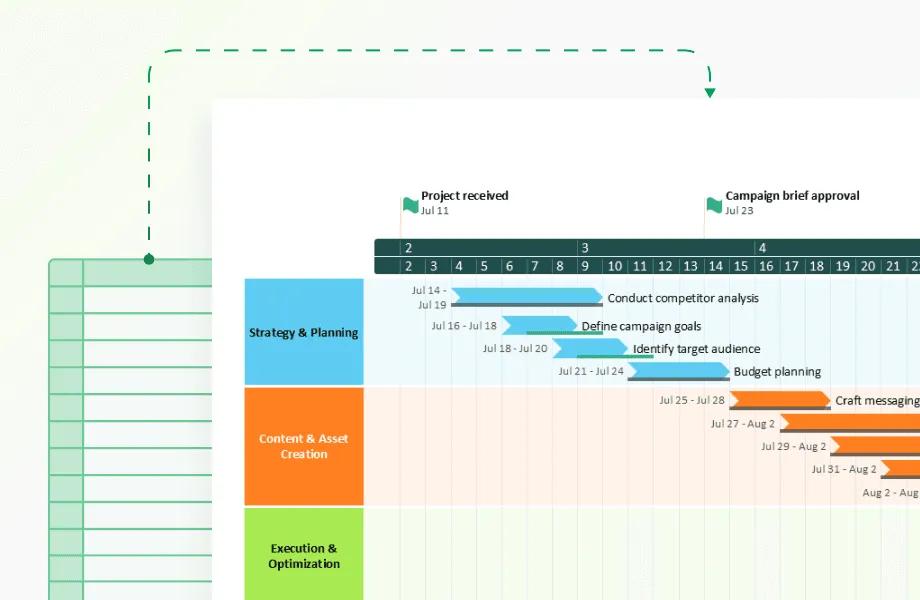
Timeline makers like Office Timeline make this process much simpler than creating timelines from scratch. You can start with professionally designed templates specifically made for historical events, then customize them with your own research. The software handles the technical formatting (adjusting dates, spacing events properly, and creating clean visual layouts) so you can focus on the historical content rather than wrestling with design.
Office Timeline's templates gallery offers useful ready-made templates for complex projects; they're designed to handle multiple simultaneous events, different time scales, and complex cause-and-effect relationships. You can easily add photos, change colors to represent different theaters of war, and create the kind of professional-looking timeline that makes historical patterns crystal clear.
Clarify history with visual timelines
Try Office Timeline for free. Create polished historical timelines that reveal how major events unfolded and influenced one another.
How timelines help us understand the world wars
After walking through both world wars, one thing becomes clear: these conflicts were won and lost based on timing. Germany's fatal mistake of fighting on two fronts, America's perfectly timed entry into both wars, and Japan's calculated risk at Pearl Harbor all depended on when events happened, not just what happened.
The patterns are striking when you see them laid out chronologically. World War I showed what happens when alliance systems create unstoppable escalation. World War II proved that unresolved conflicts don't stay buried, but resurface with greater force. Both wars demonstrate how military success depends on coordinating operations across vast distances and different time zones.
A world war timeline is the best way to understand how these massive conflicts actually worked. You'll see connections that textbooks miss: how economic pressures drove political decisions, how victories in one theater enabled operations in another, and how the timing of key decisions shaped outcomes.
Whether you're a student trying to make sense of history class or someone who wants to understand how the modern world was shaped, timeline visualization turns these complex conflicts into stories you can follow and learn from. The world wars changed everything, and timelines help you see exactly how they did it.
Frequently asked questions about world war timelines
Here are answers to some of the most common questions people have when exploring world war history and creating their own timelines.
World War I officially began on July 28, 1914, when Austria-Hungary declared war on Serbia following the assassination of Archduke Franz Ferdinand. However, the fighting effectively ended with the Armistice on November 11, 1918, at 11 AM. The formal end came with the Treaty of Versailles on June 28, 1919, exactly five years after the assassination that started it all.
Nearly every country in the world was involved in World War II in some capacity. Over 100 million people from more than 70 nations participated, making it the largest conflict in human history. The main Allied powers included the United States, United Kingdom, Soviet Union, and China, while the Axis powers were primarily Germany, Japan, and Italy. Even small nations like Haiti and Honduras declared war on the Axis powers, though their military contributions were minimal.
World War I lasted 4 years and 3 months (July 1914 to November 1918). World War II lasted 6 years (September 1939 to September 1945). Despite being longer, World War II moved much faster due to advanced technology, motorized armies, and air power that enabled rapid territorial changes.
While most sources cite September 1, 1939 (Germany's invasion of Poland), some historians argue it began with Japan's invasion of China in 1937, or even Japan's occupation of Manchuria in 1931. The confusion comes from the war's gradual expansion. It started as separate regional conflicts that eventually merged into one global war.
Absolutely. You can start with simple tools like Google Sheets or even hand-drawn timelines. The key is focusing on major events first (for example, 10-15 key moments per war) then adding detail gradually.
Tip: A professional timeline maker like Office Timeline offers a free trial that helps you create polished, presentation-ready results with minimal effort. It automatically handles all the formatting for you. The outcome looks truly professional, far beyond what you could achieve without dedicated software.