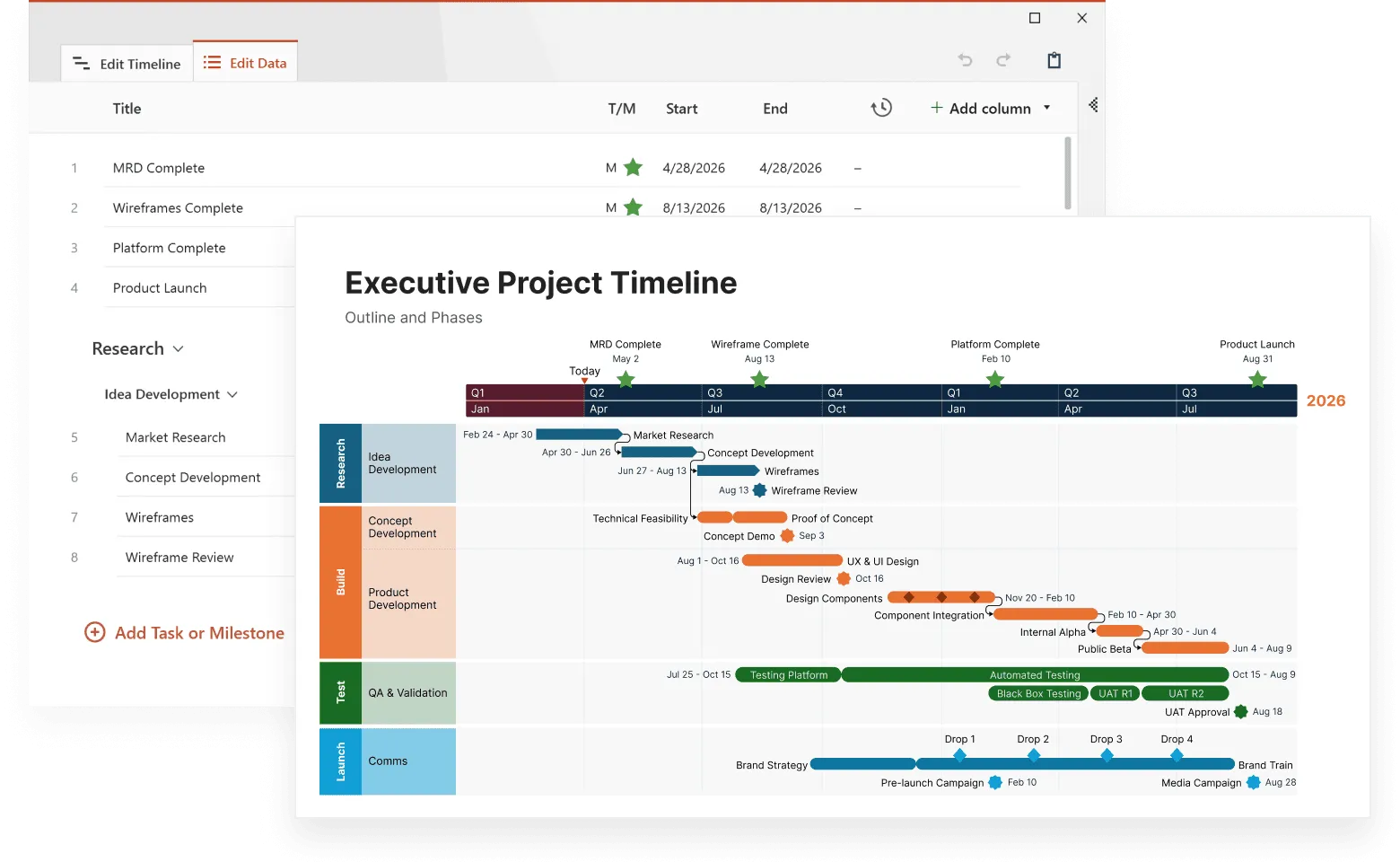
Understanding when and how history's most influential people lived gives us a clearer picture of our past. A historical figures timeline shows us the connections between different eras and helps us see how one person's actions rippled through time to change everything.
Historical figures help us connect with our past and understand the cultural forces that shaped different eras. Well-organized timelines make complex lives easier to follow by highlighting major events, achievements, and turning points. Interactive timeline tools can transform dry facts into engaging stories that bring history to life. In this article, we'll explore how to create compelling timelines that capture the full scope of remarkable lives.
To fully appreciate these individual stories, it helps to view them within the broader context of world events. Historical timelines place each figure’s life alongside key moments in politics, science, and culture, revealing how their actions were shaped by, and in turn shaped, the times they lived in.
Understanding historical figures and their impact
What draws us to the stories of people who lived centuries ago? There's something magnetic about individuals who refused to accept limitations and changed the world around them.
Take Joan of Arc, a teenage peasant girl who convinced the French king to let her lead his army against the English. Most people would dismiss such a bold claim, but she had such conviction that she turned the tide of the Hundred Years' War. Her story shows us how one person's unwavering belief can move mountains.
Historical figures fascinate us because they faced the same fundamental human struggles we do today. Abraham Lincoln battled depression throughout his life, yet he held the United States together during its greatest crisis. Vincent van Gogh sold only one painting during his lifetime and struggled with mental illness, but his art now hangs in the world's most prestigious museums.
These stories matter because they reveal patterns about human nature and success:
- Persistence pays off - Thomas Edison failed over 1,000 times before inventing the light bulb.
- Timing matters - Rosa Parks wasn't the first person to refuse to give up her bus seat, but her act of defiance came at exactly the right moment.
- Background doesn't determine destiny - Oprah Winfrey grew up in poverty but became one of the most influential media personalities in history.
We're also drawn to historical figures because they lived through extraordinary times. Cleopatra ruled Egypt when the Roman Empire was expanding across the Mediterranean. Her political alliances with Julius Caesar and Mark Antony weren't just romantic relationships - they were desperate attempts to save her kingdom from being absorbed into Rome.
The best historical figures combine relatability with the extraordinary. They made mistakes, faced setbacks, and dealt with personal problems just like us. But they also accomplished things that seemed impossible, showing us what humans can achieve when they refuse to give up.
Creating timelines for historical figures
Building a timeline for someone's life goes beyond just listing dates. You're telling a story that helps people understand how one person's experiences connected and built upon each other over time.
A good timeline shows you the big picture. When you see that Leonardo da Vinci and Christopher Columbus lived during the same period, you start to understand how the Renaissance sparked innovation in both art and exploration. These connections make history feel less like isolated events and more like interconnected human stories.
What every timeline needs
Every strong historical timeline should include these basic elements arranged in chronological order:
- Birth and early life - Where they came from and what shaped them
- Major achievements - The moments that defined their impact
- Death and legacy - How their influence continued after they were gone
- Historical context - What was happening in the world around them
Think of these as the skeleton of your timeline. Without them, you're missing parts of the story that help explain why certain events mattered so much.
Starting with origins
A person's beginnings often explain their later choices. Leonardo da Vinci was born in 1452 near Vinci, Italy, during the height of the Renaissance. Marie Curie came from Warsaw in 1867, when women had few opportunities in science. Nelson Mandela entered the world in 1918 South Africa, where racial segregation was becoming entrenched.
These birth details aren't just trivia - they set the stage for understanding what obstacles each person faced and what opportunities were available to them. A timeline that skips someone's early years misses the foundation that everything else was built on.
Highlighting defining moments
Major achievements form the heart of any timeline because they show us what made this person worth remembering. Leonardo created the Mona Lisa and The Last Supper, works that still draw millions of visitors centuries later. Marie Curie discovered radium and polonium in 1898, becoming the first woman to win a Nobel Prize and the only person to win Nobel Prizes in two different sciences.
Nelson Mandela's 27-year imprisonment became a symbol of resistance against apartheid, leading to his election as South Africa's first Black president in 1994 and his Nobel Peace Prize in 1993.
These aren't just personal victories - they're moments that changed how other people thought and acted.
Capturing the ending
How someone's story concludes often shapes how we remember them. Leonardo da Vinci's death in 1519 sparked widespread mourning across Europe. Marie Curie's passing in 1934 highlighted the sacrifices she made for science - she likely died from radiation exposure caused by her groundbreaking research.
When Nelson Mandela died in 2013, the global response showed how one person's life had touched people everywhere. Institutions and foundations established in their honor keep their work alive for future generations.
Picking the right events
Not every moment in someone's life belongs on a timeline. Focus on events that either changed the person's path or had lasting impact on others.
The key is asking yourself: "Did this event change something important?" If the answer is yes, it probably belongs on your timeline.
Organizing by life phases
Breaking someone's life into distinct periods makes their story easier to follow. Instead of jumping around chronologically, you can see how each phase built on the previous one.
This approach helps readers understand not just what happened, but how experiences shaped the person over time.
Making timelines visual and interactive
Simple visual elements can transform a basic timeline into something much more engaging. You don't need advanced design skills - just thoughtful choices about how to present information.
Color coding works well for different types of events. Interactive tools like TimelineJS let you add photos, videos, and detailed descriptions that pop up when someone clicks on an event. Instead of just reading that Charles Darwin sailed on the HMS Beagle, users can see photos of the ship and read excerpts from his journals about the Galápagos Islands.
These visual elements don't just make timelines prettier - they make the information stick better and encourage people to explore more deeply.
Examples of historical figures timelines
To bring the concept of historical figures' timelines to life, let's look at specific examples. These timelines provide a structured representation of life events and accomplishments, making it easier to understand their impact on history. We will examine the lives of Leonardo da Vinci, Wolfgang Amadeus Mozart, and Martin Luther King Jr., three individuals whose achievements have shaped modern society and continue to inspire future generations.
These examples will highlight how to incorporate key elements into a timeline and use visual aids to enhance understanding. By studying these timelines, you will see how different phases of their lives contributed to their overall legacy.
Leonardo da Vinci (1452-1519)
Leonardo's timeline shows how curiosity and talent can flourish across multiple fields. Born in 1452 near Vinci, Italy, he began his apprenticeship with Andrea del Verrocchio at just 15 years old. This early training in painting and sculpture laid the foundation for everything that followed.
His career took off when he moved to Milan in 1482, spending 17 productive years there. During this period, he completed The Last Supper and The Virgin of the Rocks while also designing flying machines and armored vehicles. This shows how Leonardo didn't separate art from science - they all fed into his understanding of the world.
Returning to Florence in 1500, he began work on the Mona Lisa around 1503 and dove deeper into anatomical studies. His final years were spent in France serving King Francis I, where he continued exploring anatomy and natural phenomena until his death in 1519.
Leonardo's timeline reveals a mind that never stopped questioning and creating, moving seamlessly between art, engineering, and science.
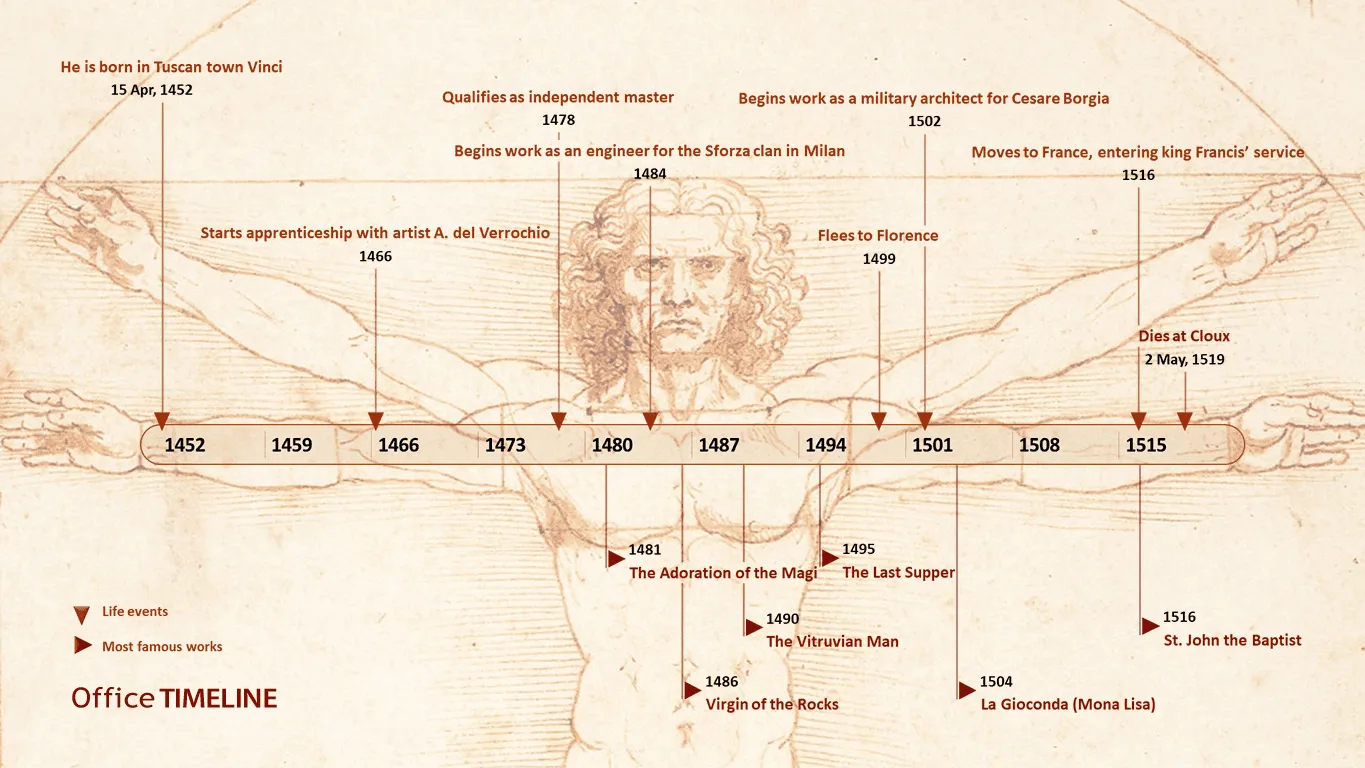
Timeline highlights:
- 1452 - Birth in Vinci, Italy
- 1467 - Begins apprenticeship with Verrocchio
- 1482 - Moves to Milan
- 1495-1498 - Creates The Last Supper
- 1500 - Returns to Florence
- 1503 - Begins Mona Lisa
- 1516 - Moves to France
- 1519 - Death at Clos Lucé
This timeline breaks Leonardo's life into clear phases based on where he lived and worked. You can see how each move brought new opportunities - Milan for large commissions, Florence for scientific study, and France for royal patronage. The spacing helps you understand which periods were most productive for different types of work.
Wolfgang Amadeus Mozart (1756-1791)
Mozart's timeline shows how extraordinary talent can emerge early and burn brightly. Born in Salzburg in 1756, he was already composing music by age 5 and performing for European royalty as a child prodigy.
His career moved fast: learning piano at 4, writing his first symphony at 8, and meeting Johann Christian Bach in 1764, who became an important influence. Mozart's tour of Italy from 1769-1771 exposed him to different musical styles that shaped his later compositions.
The middle years brought both triumph and struggle. He left the Salzburg court in 1777, traveled to Paris seeking employment, and eventually settled in Vienna in 1781. There he married Constanze Weber, befriended Joseph Haydn, and composed his greatest works including The Marriage of Figaro (1786) and The Magic Flute (1791).
Mozart's timeline shows how a brief life - just 35 years - can produce an enormous legacy when talent meets opportunity and relentless creativity.
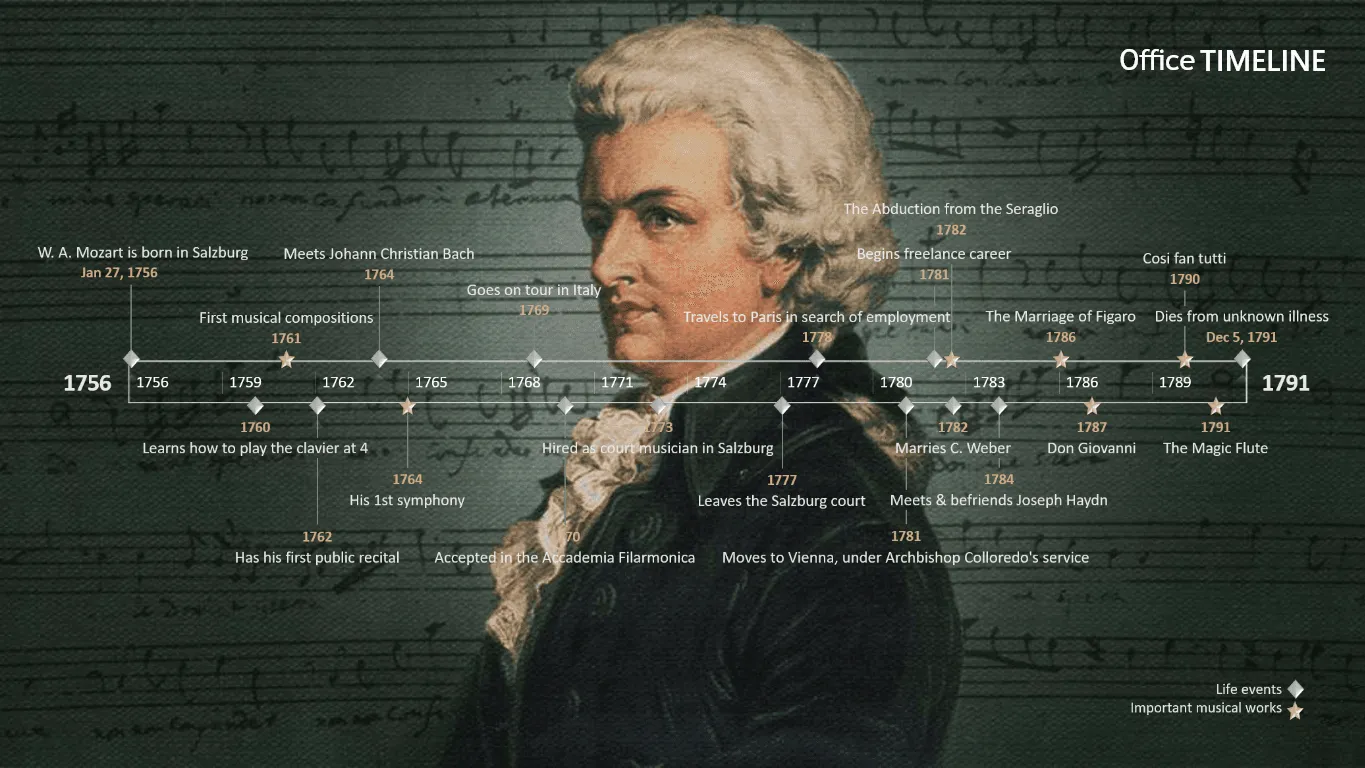
Timeline highlights:
- 1756 - Birth in Salzburg
- 1761 - First compositions
- 1764 - Meets J.C. Bach
- 1769-1771 - Italian tours
- 1777 - Leaves Salzburg court
- 1781 - Settles in Vienna
- 1782 - Marries Constanze Weber
- 1786 - The Marriage of Figaro premieres
- 1791 - The Magic Flute and death
Mozart's timeline uses different colors to separate personal events from musical works and career changes. The events cluster heavily in his Vienna years, making it clear why this period produced his most famous pieces. You can track how his early travels and training all led to this final burst of creativity.
Martin Luther King Jr. (1929-1968)
King's timeline shows how personal conviction can grow into a movement that changes history. Born in Atlanta in 1929, his early experiences with segregation shaped his worldview. His education at Morehouse College and later at Boston University gave him both theological training and exposure to nonviolent resistance philosophy.
The timeline shows turning points: his ordination as a Baptist minister in 1948, his role in the Montgomery Bus Boycott from 1955-1956, and the formation of the Southern Christian Leadership Conference in 1957. Each event built upon the previous one, expanding his influence and refining his approach.
The peak years included the March on Washington in 1963 where he delivered his "I Have a Dream" speech, receiving the Nobel Peace Prize in 1964, and leading the Poor People's Campaign. His assassination in Memphis in 1968 cut short a life dedicated to justice and equality.
King's timeline shows how sustained commitment to a cause can create lasting change, even when that life ends tragically early.
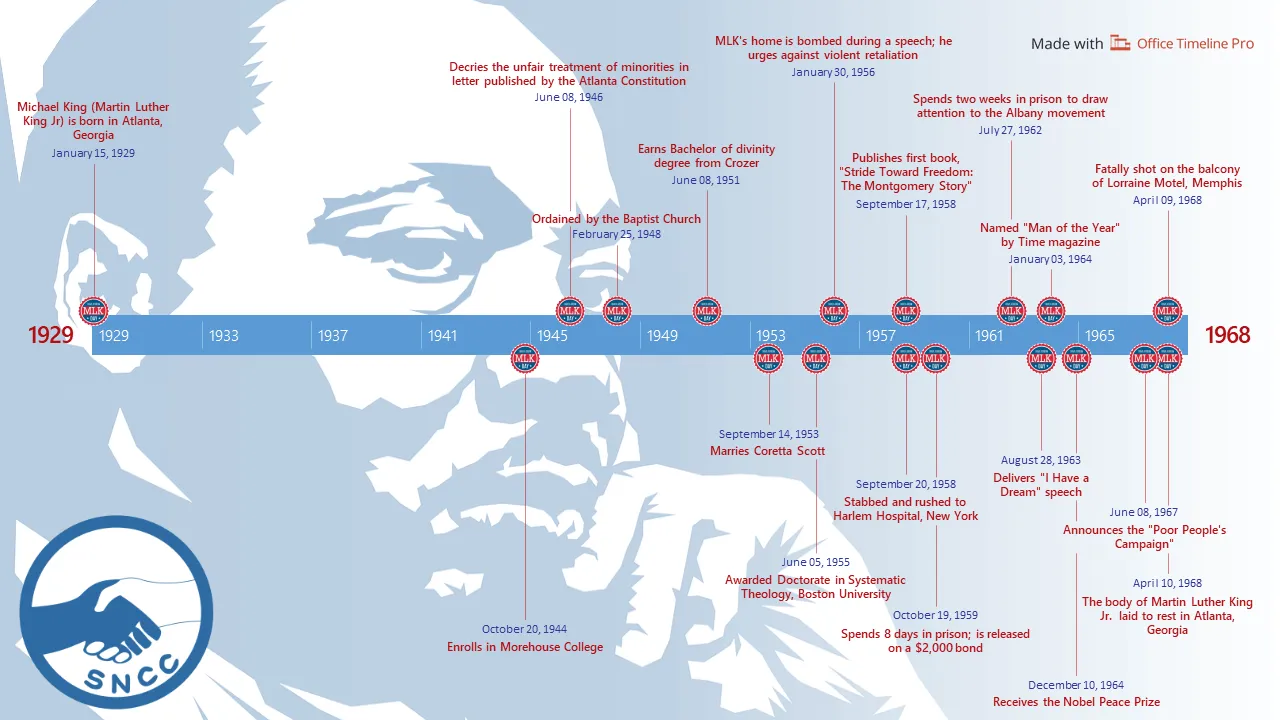
Timeline highlights:
- 1929 - Birth in Atlanta
- 1948 - Ordained as Baptist minister
- 1955-1956 - Montgomery Bus Boycott
- 1957 - Forms SCLC
- 1963 - "I Have a Dream" speech
- 1964 - Nobel Peace Prize
- 1968 - Assassination in Memphis
The King timeline uses color coding to separate personal growth from civil rights work and national recognition. This helps you see how his development as a person paralleled his growing role in the movement. The progression from local minister to international figure becomes easy to follow.
These timelines were made with Office Timeline, a professional timeline maker that transforms complex biographical data into clear, engaging visual stories. The software excels at organizing multiple types of events - personal milestones, professional achievements, and historical context - without creating visual clutter. The result is timelines that inform and engage readers and help them see the connections between events that made these figures so influential.
Timeline tools and software options
Creating historical figures timelines becomes much easier with the right digital tools. Several platforms can help you build engaging, interactive timelines that go beyond simple lists of dates.
TimelineJS stands out as a popular open-source option that connects directly to Google Sheets. You simply enter your data in a spreadsheet, and the tool automatically generates a visual timeline. The best part? When you update your spreadsheet, your timeline updates too. TimelineJS works well for adding photos, videos, and detailed descriptions to each event, making history feel more alive.
Tiki-Toki offers more advanced visual options with 3D timelines and multiple story lines. It's particularly good for showing how different people's lives intersected during the same time period. The free version covers basic needs, while paid plans unlock more customization options.
Preceden focuses on simplicity and clean design. It's straightforward to use and produces professional-looking results without much learning curve. The tool handles multiple timelines well, making it useful for comparing different historical figures side by side.
Office Timeline excels at creating polished, presentation-ready timelines that integrate seamlessly with PowerPoint. Unlike web-based tools, it runs directly in Microsoft Office, making it ideal for educators and professionals who need to include timelines in reports or presentations. The software handles complex biographical data particularly well, using colors and symbols to organize different types of events without creating visual clutter.
What sets Office Timeline apart is its focus on clarity and professional appearance. While other tools might overwhelm you with features, Office Timeline streamlines the process of turning biographical information into compelling visual narratives. The chronological layout helps viewers quickly understand a person's life span and identify the most significant moments. And you can try it for free for 14 days.
For educators working with historical figures timelines, Office Timeline's combination of ease-of-use and polished output makes it particularly valuable. The tool transforms what could be overwhelming lists of dates into engaging stories that show how individual lives shaped history.
Choosing the right tool
Your choice depends on your needs. If you want something free and web-based with multimedia support, TimelineJS works well. For more visual flair and 3D effects, consider Tiki-Toki. If you need something that integrates with your existing Microsoft Office workflow and produces consistently professional results, Office Timeline offers the best balance of functionality and polish.
Most of these tools offer free trials or basic versions, so you can test them before committing to see which interface and feature set works best for your timeline projects.
Bring historical biographies to life
Try Office Timeline for free. Create timeline visuals that make historical figures’ stories clearer, more connected, and more memorable.
Conclusion
Historical figures timelines offer a powerful way to understand how individual lives shaped our world. By organizing key events - from birth and early influences to major achievements and lasting legacy - these visual tools make complex biographical information both accessible and engaging.
The timelines we explored for Leonardo da Vinci, Mozart, and Martin Luther King Jr. show how different approaches can highlight various aspects of a person's impact. Whether tracking artistic development, scientific breakthroughs, or social change, well-constructed timelines reveal the connections between personal experiences and historical significance.
Creating your own historical figures timelines helps you see patterns across different eras and understand how various people and events influenced each other. These tools transform what could be overwhelming lists of dates into compelling stories that connect us meaningfully with the past.
Using professional timeline software like Office Timeline makes this process straightforward while producing polished results that both inform and inspire. As you explore history through timelines, you'll discover new ways to appreciate the complexities and achievements of the people who came before us.
Frequently asked questions
Creating timelines for historical figures can seem overwhelming at first. These common questions will help you understand the basics and get started with your own projects.
A historical figure timeline should highlight major life events such as birth and death dates, turning points that shaped their path, and the key achievements they’re remembered for. Include the historical context of their era (political, cultural, or technological changes) to show how their life and work fit into the broader story of history. Visual elements or quotes can also help bring their journey to life and make the timeline more engaging.
Arrange events chronologically but group them by life phases or themes. You might organize Leonardo da Vinci's timeline into his apprenticeship years, Milan period, and final years in France. This helps readers follow the progression of his artistic and scientific development.
Office Timeline works well for beginners because it integrates with PowerPoint and produces professional results without a steep learning curve. TimelineJS is another good option if you prefer free, web-based tools that connect to Google Sheets.
Include 8-15 major events for most figures. Too few events miss important developments, while too many create visual clutter. Focus on moments that either changed the person's life direction or had lasting historical impact.
While the basic structure works for everyone, change your categories to match their field. Scientists need sections for education, discoveries, published work, and awards. Political leaders require elections, major policies, and important speeches. Artists benefit from training, major works, exhibitions, and style changes. Military figures need battle dates, promotions, victories, and leadership roles. This focused approach makes each timeline more helpful for understanding their specific impact.
Use consistent colors to group related events. For example, use only blue for personal milestones, only green for professional achievements, and red for historical context. Add relevant images and keep text concise. The goal is quick comprehension, not detailed descriptions.