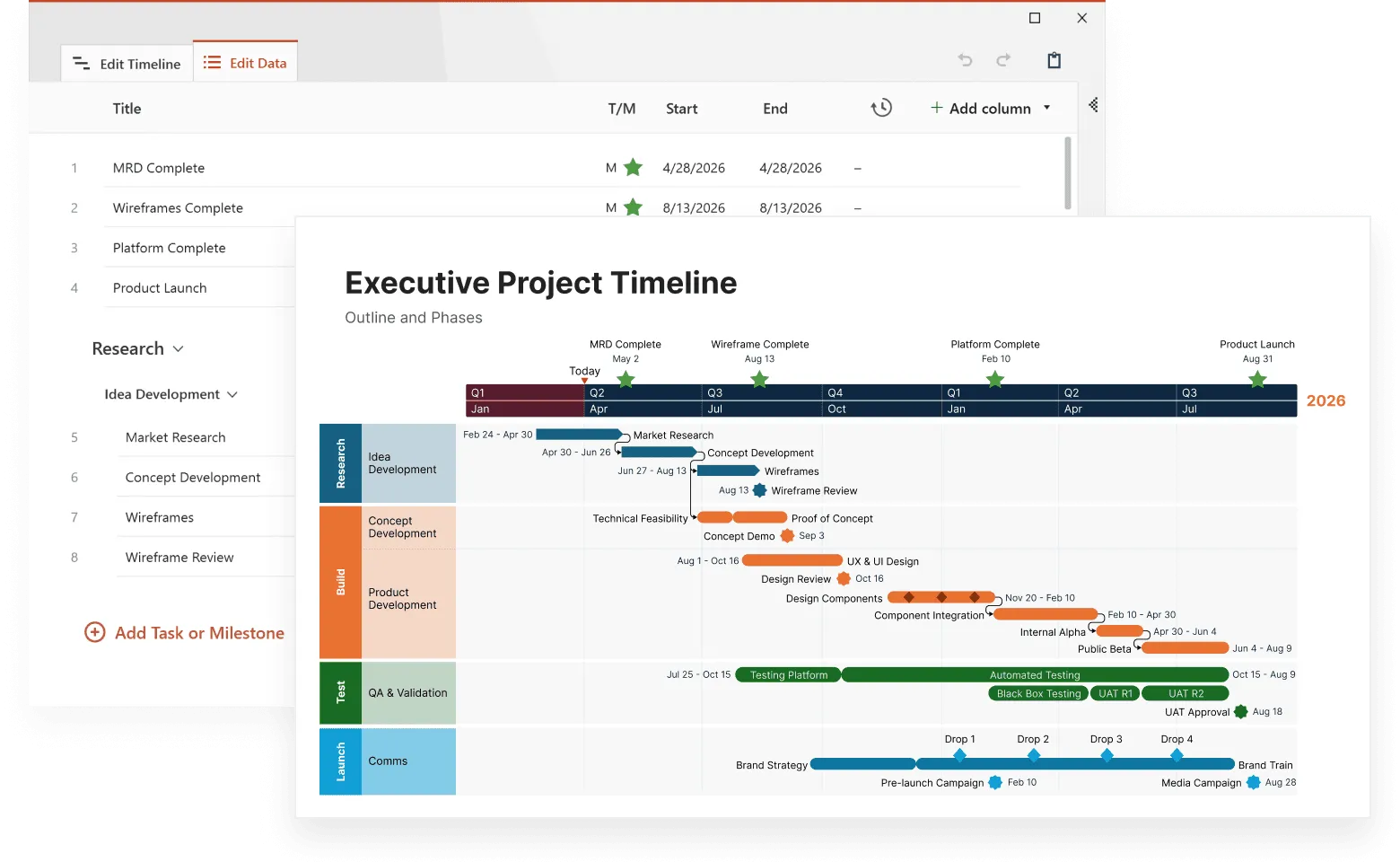
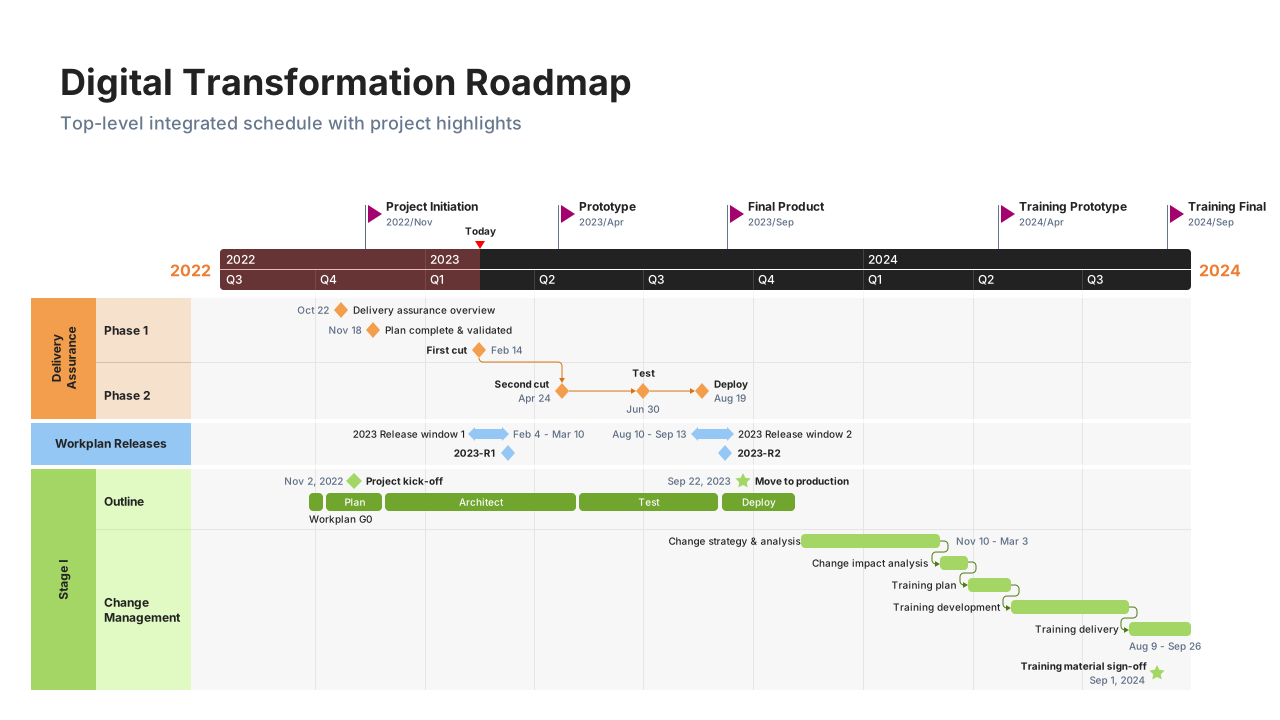
When researchers examine a single timeline, they see one story. But when they place multiple timelines side by side, patterns emerge that would remain invisible otherwise. This comparative approach transforms how we understand complex phenomena across different contexts, time periods, and domains.
Consider a project manager who notices that some software releases consistently deliver on time while others face delays. By comparing timelines from successful and delayed projects, they might discover that early user testing correlates with on-time delivery, regardless of team size or technical complexity. This insight only becomes visible through comparison.
Comparative timeline studies represent a systematic method for analyzing multiple chronological sequences to identify relationships, correlations, and divergent trends. Rather than viewing events in isolation, this methodology reveals how similar processes unfold differently across various conditions.
This article walks you through the practical steps of conducting comparative timeline studies, from data collection to insight extraction. It also builds on the same principles found in expert-level timeline analysis, offering a deeper look at how timelines interact with one another. To understand the value of comparison, let's first examine what sets this approach apart from traditional single-timeline analysis.
What makes comparative timeline studies different from regular timeline analysis
Single timeline analysis tells you what happened in one specific case. Comparative analysis tells you what happens across multiple cases.
Standard timeline analysis focuses on documenting and understanding a single sequence of events. You map milestones, identify cause-and-effect relationships, and track progress within one specific context. This approach works well for project management or historical documentation, but it can't answer broader questions about patterns and variations.
Comparative timeline studies examine multiple timelines simultaneously to answer questions that single-timeline analysis cannot address:
- How do similar processes vary across different organizations?
- What factors cause timeline divergence in comparable projects?
- Which patterns repeat across multiple contexts?
- Where do outliers occur and what drives them?
Take hiring processes as an example. A single company's hiring timeline might show that their average time-to-hire is 45 days. But comparing timelines across 20 similar companies reveals that companies with structured interview processes consistently hire 30% faster, while companies requiring multiple approval layers average 60+ days. The comparative approach reveals actionable insights that single-case analysis misses.
The comparative approach requires different analytical skills and tools. Instead of following one linear progression, researchers must identify corresponding points across multiple timelines, account for different scales and contexts, and develop frameworks for meaningful comparison.
With this foundation established, let's explore the structured methodology that makes comparative studies reliable and reproducible.
The methodology behind effective timeline comparison
Comparative timeline studies succeed or fail based on their methodological rigor. Without proper structure, comparisons become meaningless or misleading.
Successful comparative timeline studies follow structured approaches that maintain analytical rigor while accommodating the complexity of multiple data sources.
Data standardization forms the foundation. Before comparing timelines, researchers must establish common reference points, consistent time scales, and comparable metrics. This might mean converting different date formats, aligning project phases, or establishing equivalent milestones across different contexts.
For example, when comparing customer onboarding timelines across different software companies, you might need to define what constitutes "onboarding completion." Does it mean first login, first successful task completion, or reaching a usage threshold? Without standardized definitions, your comparisons become apples-to-oranges exercises.
Pattern identification techniques vary by research question. Some studies focus on temporal alignment, identifying when similar events occur across different timelines. A retail company might compare seasonal sales patterns across different product categories to optimize inventory timing.
Others examine sequence patterns, whether events consistently follow the same order. Manufacturing companies often discover that certain quality control steps, when performed in specific sequences, consistently reduce defect rates regardless of product type.
Duration analysis compares how long similar processes take in different contexts. Service companies frequently find that customer support resolution times vary dramatically between issue types, even when following supposedly standardized processes.
Context documentation proves equally important. Each timeline exists within specific conditions that influence its progression. A startup's product development timeline operates under different constraints than a Fortune 500 company's timeline. Comparative studies must capture these contextual factors to explain observed differences and similarities.
The analytical process typically involves three phases:
- individual timeline analysis to understand each sequence independently;
- cross-timeline pattern identification to spot similarities and differences;
- contextual interpretation to explain observed patterns.
Now that we've covered the methodology, let's examine how organizations across different industries apply these techniques to solve real problems.
Real-world applications
These examples show exactly how organizations use comparative timeline studies to solve specific problems and achieve measurable results.
Healthcare: optimizing patient outcomes
The challenge: A hospital system wanted to improve knee replacement recovery times while reducing costs.
Their approach: They compared recovery timelines across three rehabilitation programs, tracking when patients returned to normal activities. They controlled for variables like age, pre-surgery fitness, and surgery complexity.
Key discovery: Patients starting physical therapy within 24 hours of surgery returned to normal activities 40% faster than those waiting three days, regardless of other factors.
Business impact:
- Reduced average recovery time from 12 weeks to 8 weeks
- Cut rehabilitation costs by 25% through shorter treatment periods
- Improved patient satisfaction scores by 30%
- Created new standard protocols adopted across all locations
How you can apply this: If you manage any process with multiple approaches or protocols, compare timelines to identify which variations produce better outcomes. Look for simple changes that create significant improvements.
Technology: improving project delivery
The challenge: A software company struggled with inconsistent project delivery times and wanted to identify what made some projects succeed while others failed.
Their approach: They analyzed 200 project timelines, comparing documentation levels, team sizes, project duration, and technical complexity against delivery performance.
Key discovery: Extensive upfront documentation helped projects lasting more than three months (delivering 2 weeks faster on average) but actually slowed down shorter projects by 1 week.
Business impact:
- Reduced project delays by 35% by matching documentation levels to project length
- Saved 300+ hours per quarter by eliminating unnecessary documentation on short projects
- Improved client satisfaction through more predictable delivery timelines
- Created project classification system that guides planning decisions
How you can apply this: When you have different approaches to similar work, test whether "best practices" actually work in all situations. You might find that optimal approaches vary based on project characteristics.
Finance: predicting market recovery
The challenge: An investment firm needed better ways to advise clients during market downturns about expected recovery timelines.
Their approach: They analyzed market correction timelines from the past 30 years, identifying patterns in economic indicators that preceded different types of recoveries.
Key discovery: Corrections following specific indicator sequences had 85% probability of recovery within 6 months, while corrections with different patterns averaged 14-month recovery periods.
Business impact:
- Improved client retention during market volatility through more accurate guidance
- Reduced panic selling by 40% through data-backed recovery predictions
- Increased assets under management by positioning firm as having superior market insights
- Developed new service offering focused on market timing guidance
How you can apply this: If your business is affected by external cycles or events, analyze historical timelines to identify patterns that predict different outcomes. This helps you prepare better responses and communicate more effectively with stakeholders.
Education: optimizing learning delivery
The challenge: A university wanted to determine which courses should be offered online versus in-person to maximize student success.
Their approach: They compared completion timelines for the same courses taught in different formats, controlling for instructor quality, student demographics, and course difficulty.
Key discovery: Students completed online science courses 25% faster but took 40% longer to finish online literature courses, revealing subject-specific optimal delivery methods.
Business impact:
- Increased course completion rates by 20% through format optimization
- Reduced per-student costs by offering appropriate courses online
- Improved student satisfaction by matching learning preferences to course formats
- Created data-driven framework for deciding course delivery methods
How you can apply this: If you deliver similar services through different methods or channels, compare performance timelines to identify which approaches work best for different types of work or customer segments.
Manufacturing: reducing production delays
The challenge: An electronics manufacturer experienced inconsistent production timelines and wanted to identify root causes of delays.
Their approach: They compared assembly timelines across different product lines, shift schedules, and quality control approaches to identify factors that influenced production speed.
Key discovery: Performing quality checks immediately after each major assembly step (rather than at the end) reduced defect rates by 60% and shortened overall production time by 20%.
Business impact:
- Increased production capacity by 20% without adding equipment
- Reduced rework costs by $2M annually through earlier defect detection
- Improved customer satisfaction through faster, higher-quality delivery
- Established new quality standards adopted across all product lines
How you can apply this: Compare timelines for different process sequences or quality approaches to find methods that improve both speed and quality simultaneously.
Implementation framework for any industry
Based on these examples, here's how to apply comparative timeline analysis to your specific situation:
Step 1: Identify your key performance question. Instead of "How can we improve?" ask "What specific timeline patterns differentiate our best outcomes from our worst?"
Step 2: Choose comparable cases. Select processes, projects, or outcomes that are similar enough to compare meaningfully but different enough to reveal useful patterns.
Step 3: Control for variables that matter. Identify the 3-5 most important factors that might influence your timelines and track them consistently.
Step 4: Look for actionable patterns. Focus on findings that suggest specific changes you can implement, not just interesting observations.
Step 5: Test and measure. Implement changes based on your findings and track whether they produce the expected improvements.
The most valuable comparative timeline studies don't just identify patterns—they lead to specific actions that measurably improve business outcomes.
Analyzing patterns and drawing meaningful insights
Raw timeline data tells you what happened. Pattern analysis tells you why it matters. Pattern recognition in comparative timeline studies requires systematic approaches that balance statistical rigor with contextual understanding.
Temporal pattern analysis examines when events occur relative to each other. This reveals whether certain milestones consistently happen at specific intervals or if timing varies significantly across contexts.
A consulting firm analyzed client project timelines and discovered that successful projects consistently hit their first milestone within 15% of the planned timeframe, while projects that exceeded 25% of planned time for the first milestone had 80% probability of overall delays. This insight helped them implement early warning systems.
Sequential pattern analysis focuses on event order rather than timing. This approach identifies whether certain sequences consistently produce better outcomes than others. Manufacturing companies use this to compare production timelines and identify optimal process sequences.
One electronics manufacturer compared assembly line timelines across different product configurations. They found that performing quality checks immediately after each major assembly step, rather than at the end, reduced defect rates by 60% and shortened overall production time by 20%.
Duration pattern analysis compares how long different phases take across various timelines. This reveals bottlenecks, efficiency variations, and resource allocation patterns.
A marketing agency compared campaign development timelines and discovered that campaigns requiring client approval at more than three decision points consistently took 40% longer to complete, regardless of campaign complexity. They restructured their approval processes to batch decisions and reduced average campaign development time by 30%.
Deviation analysis identifies outliers and exceptional cases. These outliers often provide the most valuable insights, revealing unusual circumstances that lead to dramatically different outcomes.
One consulting firm found that their most successful project timelines shared a common deviation: an additional discovery phase that other projects skipped. While this phase added two weeks to project duration, it reduced change requests by 70% and improved client satisfaction scores by 35%.
The key to meaningful insight extraction lies in combining quantitative pattern identification with qualitative context analysis. Numbers reveal what happened; context explains why it happened.
Understanding these analytical approaches prepares you for the practical challenges you'll encounter when conducting your own comparative studies.
Common challenges in comparative timeline research
Even well-designed comparative studies face predictable obstacles. Here are the most common problems and practical solutions to overcome them.
Data quality inconsistencies
The problem: Different organizations collect timeline data using varying methodologies, levels of detail, and accuracy standards.
Real example: A research team comparing customer service resolution timelines discovered that some companies measured from initial contact while others measured from specialist assignment. This created a two-day variance in resolution times.
How to fix it:
- Create standardized data collection templates before starting.
- Define exactly when each timeline phase begins and ends.
- Document any assumptions or estimates made during data collection.
- Re-collect data using consistent methods when possible.
Scale and context differences
The problem: Comparing timelines across different organizational sizes or contexts can produce misleading results.
Real example: A hiring study initially showed large companies took twice as long to hire. But larger companies were filling senior positions requiring background checks and multiple interviews. When comparing equivalent roles, differences dropped to 15%.
How to fix it:
- Group similar types of projects, roles, or processes together.
- Account for resource differences (team size, budget, expertise).
- Compare relative percentages rather than absolute durations.
- Document contextual factors that might influence timing.
Selection and survivor bias
The problem: You mainly get data from successful projects or transparent organizations, skewing your results.
Real example: A software study suggested agile always outperformed waterfall, but data came mostly from successful agile implementations. Including failed agile projects revealed more nuanced results.
How to fix it:
- Actively seek out data from failed or cancelled projects.
- Include data from organizations that aren't naturally transparent.
- Acknowledge data limitations in your final analysis.
- Use multiple data sources when possible.
Uncontrolled variables
The problem: Unlike lab experiments, real-world timelines involve many factors you can't control.
How to handle it:
- Identify the 3-5 most important contextual factors.
- Collect data on these factors for each timeline.
- Group timelines by similar contexts when analyzing.
- Focus on patterns that appear across different contexts.
Quick wins to improve your study
Before you start collecting data:
- Define your measurement points precisely (What exactly counts as "project start"?).
- Create data collection templates that everyone uses the same way.
- Plan for missing data (How will you handle incomplete timelines?).
- Set realistic scope (Better to do a small study well than a large study poorly).
Understanding these challenges upfront helps you design studies that produce reliable, actionable insights rather than misleading conclusions.
Tools and techniques for timeline comparison
The right tools can make the difference between a successful comparative study and a frustrating data wrestling match. Here's how to choose the best option for your needs and budget.
Spreadsheet solutions
Best for: First-time studies, small datasets (under 50 timelines), teams without technical expertise
Tools to use:
- Excel or Google Sheets: Free and familiar to most users
- Basic pivot tables: Group timelines by phases and compare durations
- Simple charts: Bar charts showing phase lengths across different timelines
What you can accomplish:
- Compare average phase durations across timeline groups
- Identify which projects consistently take longer in specific phases
- Create basic visualizations for presentations
- Calculate percentage breakdowns of time spent in each phase
Limitations: Manual data entry, limited pattern detection, no statistical testing
Business intelligence platforms
Best for: Regular comparative studies, medium datasets (50-500 timelines), business teams wanting professional visuals
Top choices:
- Tableau: Excellent for interactive timeline dashboards
- Power BI: Strong Microsoft integration, good for Office 365 users
- Looker: Google's cloud-based business intelligence platform with good collaboration features
What you can accomplish:
- Interactive dashboards that stakeholders can explore themselves
- Automatic pattern highlighting and outlier detection
- Professional-quality reports and presentations
- Real-time updates when new timeline data becomes available
Cost: $15-70/month per user Learning curve: 1-2 weeks for basic proficiency
Statistical software for advanced analysis
Best for: Large datasets (500+ timelines), researchers needing statistical validation, predictive modeling
Top choices:
- R with timelineS package: Free, most flexible for timeline-specific analysis
- Python with plotly: Great for interactive visualizations and web integration
- SPSS: User-friendly interface for non-programmers
What you can accomplish:
- Statistical significance testing of observed patterns
- Machine learning pattern detection in large datasets
- Predictive modeling based on timeline patterns
- Custom analysis methods tailored to your specific research questions
Real example: A retail company used Python to analyze 10,000 product launch timelines, discovering six distinct patterns that predicted success rates with 78% accuracy.
Specialized timeline platforms
Best for: Teams doing regular timeline work, collaborative projects, organizations needing timeline-specific features
Top choices:
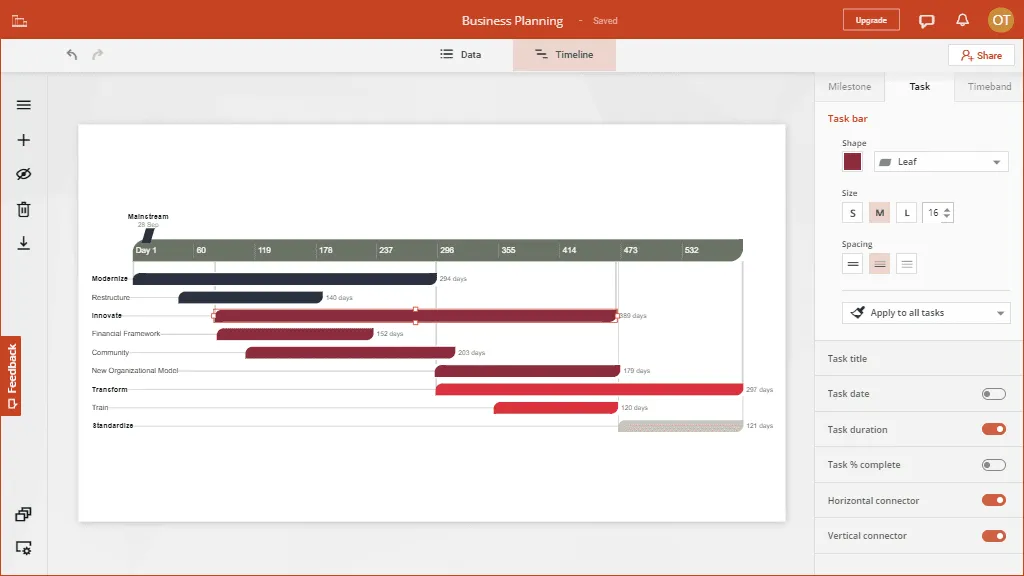
- Office Timeline Online: A browser-based timeline creator built for teams that need consistent, professional timelines. Ideal for comparing multiple timelines side by side in a clean, presentation-ready format.
- Aeon Timeline: User-friendly with built-in comparison features.
- TimelineJS: Free, web-based, good for public-facing timelines.
- Preceden: Simple interface, good for project timelines.
What you can accomplish:
- multi-timeline projects with easy comparison views;
- collaborative timeline building with team members;
- timeline templates for consistent data collection;
- export capabilities for further analysis in other tools.
Cost: $0-50/month depending on features needed
Compare timelines with ease
Try Office Timeline Online for free. Create clean, side-by-side timeline views directly in your browser. Perfect for analyzing multiple data streams.
Quick decision guide
Choose your tool based on these questions:
How many timelines are you comparing?
- Under 20: Spreadsheets work fine
- 20-100: Business intelligence platforms
- 100+: Statistical software or specialized platforms
What's your technical comfort level?
- Beginner: Spreadsheets or specialized timeline platforms
- Intermediate: Business intelligence platforms
- Advanced: Statistical software
How often will you do this analysis?
- One-time study: Use what you already have (likely spreadsheets)
- Monthly/quarterly: Invest in business intelligence platforms
- Ongoing research: Statistical software or specialized platforms
What's your budget?
- Free: Excel/Google Sheets, R, Python, TimelineJS
- Under $100/month: Most business intelligence platforms
- Higher budget: Enterprise versions with advanced features
Getting started checklist
Before diving into any tool:
- Clean your data first: Standardize date formats, phase names, and measurement points
- Start with a pilot study: Test your approach on 5-10 timelines before scaling up
- Define success metrics: Know what patterns or insights you're looking for
- Plan for collaboration: Consider who else needs to access or update the analysis
- Think about repeatability: Choose tools that can handle future timeline additions
The best tool is the one your team will actually use consistently. Start simple and upgrade as your needs become more sophisticated.
Building more effective comparative timeline studies
Good comparative studies don't happen by accident. Follow this step-by-step framework to design studies that produce actionable insights.
Step 1: Define specific research questions
Instead of vague questions like:
- "How do our timelines compare to others?"
- "What can we learn from our project data?"
Ask specific, actionable questions like:
- "What timeline patterns differentiate successful projects from failed ones?"
- "Which early-stage factors predict schedule delays?"
- "How do timeline patterns vary between different team sizes?"
- "What causes some projects to accelerate while others slow down?"
Quick test: Can you imagine making a specific business decision based on the answer? If not, refine your question.
Step 2: Plan your data collection strategy
Start with minimum viable data:
- project/process start and end dates;
- 3-5 major milestone dates;
- final outcome (success/failure, on-time/delayed);
- basic context (team size, budget, complexity).
Add layers for deeper analysis:
- detailed sub-process timelines;
- resource allocation changes;
- external factors (market conditions, regulatory changes);
- decision points and approval delays.
Pro tip: Collect basic data for all timelines, detailed data for your most important cases. This gives you broad patterns plus deep insights where they matter most.
Step 3: Standardize everything upfront
Create a data collection template that includes:
Timeline definitions:
What exactly counts as "project start"? (Approval? First work day? Budget allocation?)
How do you handle projects that pause and restart?
What defines project completion? (Delivery? Client acceptance? Go-live?)Phase standardization:
Use the same phase names across all timelines.
Define what activities belong in each phase.
Specify how to handle phases that overlap or happen out of orderContext variables:
- team size categories (small: 1-3, medium: 4-8, large: 9+);
- budget ranges that make sense for your organization;
- complexity ratings (simple, moderate, complex).
Step 4: Build in validation from the start
Cross-validation approach:
- Split your timeline data into two groups randomly.
- Look for patterns in the first group.
- Test if those same patterns appear in the second group.
- Only trust patterns that show up in both groups.
Reality check methods:
- Show findings to domain experts who know the processes well.
- Test patterns on new timeline data as it becomes available.
- Look for logical cause-and-effect explanations for observed patterns.
Red flags to watch for:
- patterns that only appear in one subset of your data;
- results that contradict everything experts know about the process;
- correlations without plausible causal explanations.
Step 5: Engage stakeholders throughout
Before starting:
- Interview process experts to understand what factors might influence timelines.
- Get input on which contextual variables to track.
- Validate your timeline phase definitions.
During analysis:
- Share preliminary patterns and get expert reactions.
- Ask if findings align with their experience.
- Get suggestions for additional factors to investigate.
After completing:
- Present findings to stakeholders who will use the insights.
- Get feedback on practical applications.
Plan follow-up studies based on remaining questions.
Common mistakes to avoid
- Mistake #1: Starting data collection without clear standardization
Fix: Spend 20% of your time upfront defining exactly what you're measuring - Mistake #2: Trying to collect everything about every timeline
Fix: Use a layered approach—basic data for all, detailed data for key cases - Mistake #3: Analyzing data in isolation without expert input
Fix: Regular check-ins with people who understand the processes - Mistake #4: Stopping at pattern identification without validation
Fix: Always test patterns on new data or with independent methods
Success checklist
Before starting your study, confirm you can answer "yes" to these questions:
- Can you explain your research question to someone in 30 seconds?
- Do you have standardized definitions for all timeline phases?
- Have you identified 3-5 contextual factors that might influence timelines?
- Do you have a plan for validating any patterns you find?
- Have you talked to at least 2 domain experts about your approach?
- Do you know how you'll handle missing or incomplete timeline data?
Follow this framework and the studies that you can build using it will be more reliable, and will produce actionable insights rather than interesting but unusable observations.
Future directions in comparative timeline analysis
The field continues evolving rapidly. Here's what's coming next and how you can prepare to take advantage of new capabilities.
Real-time timeline analysis
Organizations are rapidly moving beyond post-project analysis to monitor timelines as they unfold. This shift enables immediate course corrections rather than after-the-fact lessons learned.
Manufacturing lines now automatically adjust when production falls behind schedule, while software teams receive alerts when sprint patterns indicate likely delays. Customer service teams redistribute workload based on real-time resolution patterns, preventing bottlenecks before they impact service levels.
To prepare for this shift, start collecting more granular timeline data now. Instead of tracking only major milestones, capture daily or weekly progress updates. Identify which timeline deviations matter most to your organization and establish thresholds that warrant immediate attention. Test simple alerts based on current patterns, such as flagging projects that fall 20% behind schedule by week three.
You can begin implementing this approach today by setting up automated reports that track timeline progress weekly instead of waiting until project completion. This small change provides valuable experience with real-time monitoring while building the foundation for more sophisticated systems.
Machine learning pattern detection
Artificial intelligence is becoming capable of spotting timeline patterns that humans miss, especially in large datasets with complex interdependencies. A logistics company exemplifies this potential by predicting delivery delays 72 hours in advance compared to 12 hours with traditional methods. They achieved this by analyzing millions of delivery timelines to identify subtle early indicators that human analysts overlooked.
Machine learning makes sense when you have 500 or more timelines to analyze, when timeline patterns involve many complex variables, and when early warning of problems would save significant money or time. However, implementing these solutions requires technical resources and clean, standardized data.
Getting started involves cleaning and standardizing your existing timeline data first. Begin with simple pattern detection before moving to complex machine learning implementations. Consider partnering with data science teams or consultants for initial projects, and focus on solving one specific prediction problem rather than attempting to address everything simultaneously.
Cross-industry pattern discovery
Researchers increasingly discover that similar timeline patterns appear across completely different industries. Software development and construction projects, for instance, show remarkably similar patterns in how scope changes affect completion times. These insights led to improved change management processes in both fields, demonstrating the value of looking beyond industry boundaries.
This cross-pollination offers practical benefits by allowing you to learn from industries that have already solved similar timeline challenges. You can apply proven solutions from other domains to your problems and identify universal principles that work across different contexts.
To explore cross-industry insights, look for timeline studies in industries facing similar challenges such as tight deadlines, resource constraints, or quality requirements. Attend cross-industry conferences focused on project management or operations, and test whether patterns discovered in other industries apply to your specific timeline challenges.
Predictive timeline modeling
The field is evolving from describing what happened to forecasting what will happen based on early timeline indicators. Current capabilities include predicting project completion dates with 80% or higher accuracy after just 25% completion, identifying high-risk projects before major problems develop, and forecasting resource needs based on timeline progression patterns.
Implementing predictive modeling follows a logical progression. In the first three months, identify three to five early indicators that correlate with timeline outcomes, create simple alert systems based on these indicators, and test predictions on current projects.
Over the following nine months, build more sophisticated models using historical timeline data, automate predictions and integrate them with project management systems, and train teams to act on predictive insights. In the longer term, implement real-time prediction systems, use predictions for resource planning and risk management, and continuously improve models based on new timeline data.
Preparing your organization
Success with these emerging capabilities requires building the right foundation. Your data infrastructure needs standardized timeline data collection across all projects, regular quality audits and validation processes, and systems that capture timeline data automatically whenever possible.
Skill development becomes equally important. Train team members in basic timeline analysis techniques, develop relationships with data science resources, and stay current with timeline analysis tools and methodologies.
Cultural changes must accompany technical improvements by shifting from reactive to proactive timeline management, encouraging data-driven decision making, and creating feedback loops that improve timeline predictions over time.
Strategic focus areas
Your current experience level should guide your next steps. If you're just starting with comparative timeline analysis, master the basics before pursuing advanced techniques. Build a solid foundation of clean, standardized timeline data and focus on actionable insights rather than sophisticated methods.
For those experienced with timeline analysis, experiment with real-time monitoring of key timeline indicators, explore machine learning tools for pattern detection, and look for cross-industry insights that might apply to your work.
If you're leading timeline analysis initiatives, invest in data infrastructure that supports future advanced analytics, build teams with both domain expertise and analytical skills, and create systems that can scale as timeline datasets grow.
The most successful organizations won't necessarily be the first to adopt every new technique, but they'll be ready to implement proven methods when they become practical and cost-effective. By building strong foundations now and staying informed about emerging capabilities, you position your organization to benefit from the next generation of comparative timeline analysis tools and techniques.
Conclusion
Comparative timeline studies reveal insights that single-timeline analysis simply cannot provide. By systematically comparing multiple chronological sequences, researchers identify patterns, relationships, and principles that improve decision-making across numerous domains.
The methodology requires careful attention to data quality, appropriate analytical techniques, and realistic scope definition. While challenges exist, the insights generated often justify the additional complexity compared to single-timeline analysis.
Success in comparative timeline studies comes from combining rigorous methodology with practical application. The most valuable studies don't just identify patterns - they translate those patterns into actionable strategies that improve real-world outcomes.
As data collection becomes more sophisticated and analytical tools more powerful, comparative timeline studies will likely become standard practice for understanding complex processes and improving outcomes across various fields.
Frequently asked questions
These are the most common questions people ask when planning their first comparative timeline study. Each answer is designed to help you make practical decisions and avoid common pitfalls.
You need at least 3-5 timelines to spot basic patterns, but 8-12 timelines provide much more reliable insights.
Here's the practical breakdown:
- 3-5 timelines: Good for initial pattern spotting and proof-of-concept studies.
- 8-12 timelines: Ideal for most business applications and confident decision-making.
- 15+ timelines: Required for statistical significance and robust pattern validation.
- 30+ timelines: Needed for predictive modeling and advanced pattern recognition.
The exact number depends on what you're studying. Simple process comparisons work with fewer timelines, while complex organizational studies need larger datasets.
Focus on phases and percentages instead of absolute time periods.
Instead of comparing raw durations, convert everything to relative measures. For example, if one project took 6 months and another took 18 months, compare what percentage of time each spent in planning (maybe 20% vs 35%) rather than absolute weeks. You can also:
- identify equivalent milestones across all timelines;
- create standardized phase definitions that apply to all cases;
- use completion percentages as your common measuring stick;
- focus on sequence patterns rather than timing patterns.
Yes, but treat predictions as educated estimates rather than guarantees.
Timeline comparisons excel at identifying early warning signs and success indicators. If you consistently see that projects starting with certain patterns end up delayed, that's actionable intelligence. However, prediction accuracy varies significantly based on how similar your future situation is to your historical data. Use these insights to:
- set up early warning systems;
- adjust resource allocation proactively;
- make more informed timeline estimates;
- identify high-risk project characteristics.
Start with Excel or Google Sheets for your first comparative study.
Most people overcomplicate their first attempt. You can create meaningful timeline comparisons using basic spreadsheet functions:
- Set up columns: Timeline name, phase, start date, end date, duration, outcome.
- Standardize phases: Use the same phase names across all timelines.
- Create pivot tables: Group by phase to compare average durations.
- Make simple charts: Bar charts showing phase lengths work well.
Once you prove the value with simple tools, you can justify investing in specialized software like Tableau, R, or dedicated timeline platforms.
Look for patterns that appear consistently across multiple timeline groups and make logical sense.
Real patterns show up repeatedly and have plausible explanations. Test your findings by:
- splitting your timeline data in half and seeing if patterns appear in both groups;
- asking domain experts if the patterns align with their experience;
- looking for logical cause-and-effect relationships;
- testing patterns on new timeline data when it becomes available.
If a pattern only appears in one subset of your data or seems to contradict everything you know about the process, it's probably coincidental.
Trying to compare timelines without first standardizing what events and phases mean across different cases.
Without standardization, you end up comparing apples to oranges. Spend time upfront defining:
- what constitutes project start and end points;
- how to handle projects that were paused or restarted;
- standard phase definitions that apply across all cases;
- how to categorize different types of delays or accelerations.
This preparation work determines whether your analysis produces meaningful insights or misleading conclusions.